
Field InsightsField Insights
2026年2月17日
Electric Cargo Tricycle for Port Internal Logistics in UAE and Netherlands
Electric Cargo Tricycle for Port Internal Logistics in UAE and Netherlands —— From Auxiliary Tool to Strategic Port Operational Asset In the global maritime trade network, the United Arab Emirates a
Electric Cargo Tricycle for Port Internal Logistics in UAE and Netherlands
——From Auxiliary Tool to Strategic Port Operational Asset
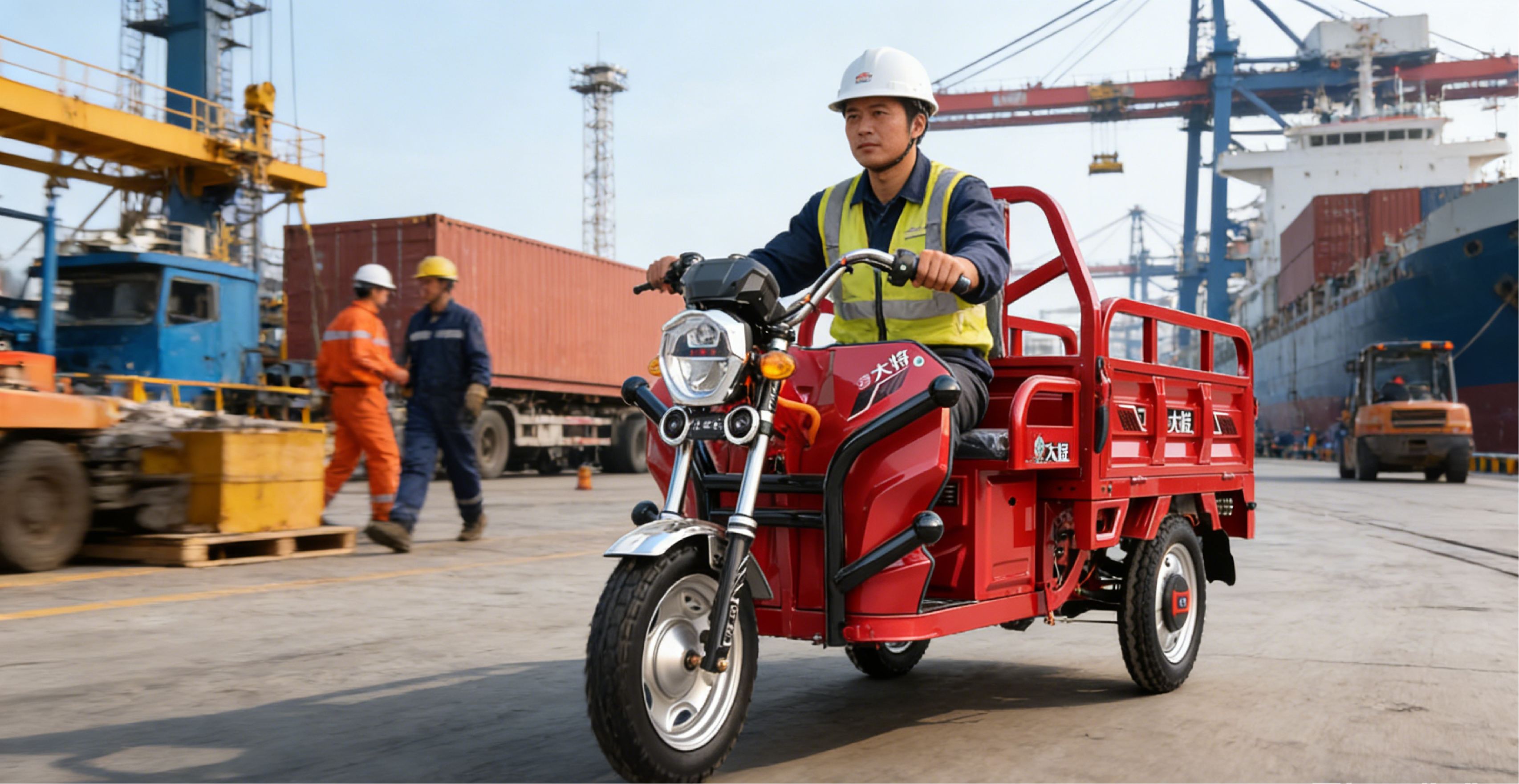
In the global maritime trade network, the United Arab Emirates and the Netherlands occupy critical strategic positions. Major ports such as Jebel Ali Port, Khalifa Port, and Europe’s largest seaport, the Port of Rotterdam, are not only international cargo gateways but also highly integrated logistics ecosystems.
As throughput continues to increase and operational complexity expands, port internal logistics has become a decisive factor in overall efficiency. Beyond container loading and vessel turnaround, ports rely heavily on short-distance, high-frequency internal transport activities. These include spare parts delivery, maintenance support, light cargo distribution, document transfer, and technical team mobility within container terminals, bonded warehouses, shipyards, and yard areas.
Such tasks share three operational characteristics: short routes, repetitive movement, and high daily frequency. However, in many cases they are still executed using diesel pickup trucks, small fuel vans, or forklifts—vehicles designed for heavier-duty applications. This structural mismatch results in excessive fuel consumption, higher maintenance burdens, inefficient asset allocation, and avoidable operating costs.
Within this context, the electric cargo tricycle is emerging as a specialized and operationally aligned solution for port internal logistics in both UAE and Netherlands port environments.
Structural Limitations of Conventional Internal Transport Vehicles
Port internal cargo transfer traditionally relies on several types of light transport equipment:
- Diesel light-duty trucks and small vans
- Electric tuggers pulling trailer units
- Manual carts for ultra-short distances
- Forklifts for loading, stacking, and heavier movement
While each serves a specific function, none are fully optimized for repetitive light-load, short-distance internal transport.
Diesel vehicles provide strong load capacity and extended range but are economically inefficient for frequent stop-and-go operations. Forklifts are essential for stacking and container handling but are not designed for routine internal mobility tasks. Manual carts reduce capital cost but increase labor intensity and limit productivity. Electric tuggers are useful for towing standardized units but lack flexibility for decentralized transport points.
This functional misalignment leads to unnecessary energy use and inflated total cost of ownership (TCO) in port logistics fleets.
Why Electric Cargo Tricycles Are Operationally Matched to Port Logistics
An electric cargo tricycle is specifically suited to port internal logistics because it aligns with the real operational intensity of light cargo transport.
Its compact structure and small turning radius allow efficient maneuvering within container terminals, maintenance zones, narrow access lanes, and congested yard environments. The vehicle’s energy consumption is directly proportional to travel distance, enabling predictable and controllable operating costs.
Key operational advantages include:
- High maneuverability in confined industrial spaces
- Low energy consumption per kilometer
- Reduced mechanical complexity
- Fast deployment without infrastructure overhaul
- Suitability for high-frequency, multi-shift operations
Rather than replacing heavy-duty fleet assets, electric three wheel vehicles optimize task segmentation within port operations. Light-duty internal logistics can be handled by lightweight electric vehicles, allowing larger diesel equipment to focus on core loading and long-distance transport functions.
This structured fleet division improves overall system efficiency and resource utilization.
Industrial-Grade Requirements in UAE and Netherlands Ports
Port vehicles must operate under harsh environmental conditions. In UAE ports, high ambient temperatures and dust exposure are constant operational factors. In Netherlands ports such as Rotterdam, humidity, salt air, and coastal corrosion present structural durability challenges.
Therefore, electric cargo tricycles used in port environments must be engineered as industrial electric vehicles rather than consumer-grade transport products.
Critical design considerations include:
- Chassis reinforcement based on actual load intensity
- Anti-corrosion coatings suitable for saline environments
- Electrical system protection against dust and humidity
- Durable suspension and braking systems for frequent start-stop cycles
- Component selection aligned with continuous daily operation
The engineering objective is not to maximize specifications blindly, but to ensure environmental matching and operational stability. Proper configuration enhances vehicle availability and reduces long-term failure risk.
Systematic Configuration: Avoiding Over-Specification
In port internal logistics, operational efficiency depends on configuration matching rather than parameter escalation.
Battery capacity, for example, must correspond to real daily duty cycles. Most port internal transport follows a high-frequency daytime operation model with centralized overnight charging. In such scenarios, excessively large battery packs increase procurement cost and vehicle weight without proportional operational benefit.
An optimized electric cargo tricycle configuration includes:
- Sufficient battery capacity for full-shift operation
- Balanced structural weight for maneuverability
- Simplified mechanical architecture to reduce failure points
- Modular design for easier maintenance and fleet management integration
This approach ensures the vehicle integrates into the port’s asset management system rather than becoming an isolated piece of equipment.
Total Cost of Ownership (TCO) in High-Frequency Port Environments
For port operators in UAE and the Netherlands, procurement decisions increasingly focus on lifecycle economics rather than initial acquisition price.
In high-frequency internal logistics operations, electric cargo tricycles demonstrate measurable TCO advantages:
- Lower energy cost compared to diesel fuel
- Reduced maintenance frequency due to simplified drivetrain
- Fewer wear-intensive components
- Shorter downtime and improved fleet availability
- More predictable annual operating expenses
Under continuous operational use, accumulated savings in fuel and maintenance can significantly reduce yearly operating expenditure. This cost structure transforms electric cargo tricycles from a budget line item into a strategic cost-optimization asset.
Contribution to Green Port and Low-Carbon Strategies
Port authorities and operators such as DP World and AD Ports Group, along with European port administrations, are actively advancing green port initiatives.
Reducing emissions in internal transport segments represents a practical and immediately actionable pathway. Electric cargo tricycles contribute by:
- Eliminating local tailpipe emissions
- Reducing fossil fuel dependence in routine operations
- Enabling scalable electrification of light-duty logistics
- Supporting measurable carbon reduction targets
Because these vehicles require minimal infrastructure modification, they provide a realistic and phased transition mechanism toward broader fleet electrification.
Repositioning the Vehicle: From Utility Tool to Operational Asset
Modern port operations demand structured fleet management and task allocation. Vehicles must be integrated into digital asset systems, maintenance scheduling frameworks, and operational performance monitoring processes.
By assigning light internal logistics tasks to electric cargo tricycles and reserving heavy-duty equipment for container handling and bulk transport, port operators achieve:
- Higher fleet utilization efficiency
- Reduced operational redundancy
- Improved cost allocation transparency
- Better environmental performance metrics
In both UAE and Netherlands port ecosystems, electric cargo tricycles are transitioning from peripheral utility tools to structured components of industrial logistics infrastructure.
Their value lies not merely in electrification, but in operational alignment, lifecycle cost efficiency, and sustainability integration.
Frequently Asked Questions (FAQ)
What is the primary role of an electric cargo tricycle in port internal logistics?
It is used for short-distance cargo transport, spare parts distribution, maintenance support, and repetitive internal transfer tasks within container terminals and port facilities.
Are electric cargo tricycles reliable in harsh coastal port environments?
Yes. Industrial-grade models with reinforced chassis, anti-corrosion treatment, and protected electrical systems are engineered for high-temperature, humid, and saline environments.
How does the total cost of ownership compare to diesel light-duty vehicles?
In high-frequency short-distance operations, electric cargo tricycles typically demonstrate lower energy consumption and maintenance costs, leading to reduced overall TCO.
Can these vehicles be integrated into structured fleet management systems?
Yes. With appropriate configuration and maintenance planning, they can be incorporated into standardized port asset management systems.