
Field InsightsField Insights
2026年2月12日
Global Trends in Electric Tricycle Motors and Batteries: From Europe to Southeast Asia
Global Trends in Electric Tricycle Motors and Batteries: From Europe to Southeast Asia 1. Why Does Motor–Battery Matching Determine the Lifespan of an Electric Tricycle? In an electric tricycle syst
Global Trends in Electric Tricycle Motors and Batteries: From Europe to Southeast Asia
1. Why Does Motor–Battery Matching Determine the Lifespan of an Electric Tricycle?
In an electric tricycle system, the compatibility between motor power and battery capacity is the core factor that determines overall performance and battery lifespan.
Many users assume that “a higher motor power is always better,” but if the battery cannot sustain the motor’s instantaneous or continuous energy demand, the result is usually reduced performance, shortened lifespan, and even safety hazards.
This mismatch typically manifests in three ways:
1.1Current Overload — Accelerated Plate Damage
For example, a 60V 20Ah lead-acid battery has a rated discharge current of around 10A.
When paired with a 1500W motor, the startup torque can draw an instantaneous current of about 50A, nearly five times the rated current.
Prolonged overload causes active material shedding and structural damage inside the battery, accelerating capacity decay at a rate 3–5 times faster than a properly matched configuration.
1.2 Continuous High Temperature — Accelerated Electrolyte Aging
High-power motors (e.g., 3000W and above) operating for extended periods can significantly raise the battery temperature, sometimes reaching 60°C.
Empirical data shows that for every 10°C increase in temperature, the battery lifespan shortens by about 50%.
At temperatures above 60°C, not only does the capacity drop sharply, but issues such as swelling, electrolyte leakage, or even thermal runaway may occur.
1.3Frequent Charge–Discharge Cycles — Rapid Lifetime Degradation
A small-capacity battery (e.g., 48V 12Ah) paired with a high-power motor offers very limited range (around 30 km per charge).
This forces users to recharge frequently.
For lead-acid batteries, which typically have 300–400 charge cycles, such frequent cycling can lead to battery failure within a year, dramatically increasing operational costs.
Conclusion:
An improperly matched motor–battery system not only compromises immediate performance but also raises the total cost of ownership (TCO) and increases safety risks over time.
2. In-depth Analysis of 2000W & 1500W Motor Systems: LiFePO₄ Battery Matching
2.1Relationship Between Power and Current
Formula: P=V×IP = V \times IP=V×I
Where:
PPP = motor power (W)
VVV = voltage (V)
III = current (A)
2000W Motor:
Voltage | Current (A) | System Characteristics |
72V | 2000 ÷ 72 ≈ 27.8A | Lower heat generation, higher efficiency, recommended as first choice |
60V | 2000 ÷ 60 ≈ 33.3A | Higher current, requires high discharge-rate battery |
If the target runtime is 2 hours, the required battery capacity is calculated as:
72V system: 27.8×2÷0.8≈69.5Ah
60V system: 33.3×2÷0.8≈83.3Ah
Conclusion: 72V 70–80Ah is the optimal battery capacity range for a 2000W motor.
1500W Motor:
Voltage | Current (A) | System Characteristics |
72V | 1500 ÷ 72 ≈ 20.8A | Lower heat generation, higher efficiency, recommended as first choice |
60V | 1500 ÷ 60 ≈ 25A | Higher current, requires high discharge-rate battery |
If the target runtime is 2 hours, the required battery capacity is calculated as:
72V system: 20.8×2÷0.8≈52Ah
60V system: 25×2÷0.8≈62.5A
Conclusion: 72V 50–60Ah is the optimal battery capacity range for a 1500W motor.
2.2 Key Summary
The higher the motor power, the higher the required current, which demands larger battery capacity and higher discharge capability.
Compared with 60V systems, 72V systems draw less current and generate less heat at the same power, making them a safer and more efficient choice.
Improper matching may lead to insufficient range, excessive battery temperature rise, and significantly shortened battery lifespan.
3.Recommended Motor and Battery Configurations for Different Usage Scenarios
Usage Scenario | Recommended Battery | Motor Power | Estimated Range (50 km/h) | Key Advantages |
Short-distance Cargo (≤50 km) | 72V50–60Ah | 1500W | ~50–60 km | Low cost, lightweight structure; ideal for light-load short-distance delivery |
Medium-distance Cargo (≈80 km) | 72V70–80Ah | 2000W | ~80–100 km | Balanced range and cost; suitable for medium-load transportation |
Long-distance Heavy Cargo (≈120 km) | 72V120–150Ah | 2000W | ~120–130 km | High capacity; suitable for mountainous and long-distance transport |
Extreme Heavy Load or Steep Climb | 72V150–200Ah | 2000–2500W | Dynamic adjustment | Reserve capacity for high loads or steep climbs; suitable for special operating conditions |
Explanation & Recommendations:
- Short-distance Cargo (≤50 km): Use a 1500W motor with a 72V50–60Ah battery for light loads, low cost, and a compact vehicle structure.
- Medium-distance Cargo (≈80 km): Recommend a 2000W motor with a 72V70–80Ah battery to balance range and cost, suitable for medium-load operations.
- Long-distance Heavy Cargo (≈120 km): Suggest a 2000W motor with a 72V120–150Ah battery to meet high capacity requirements, ensuring reliable long-distance transport.
- Extreme Heavy Load or Steep Climb: A 2000–2500W motor with a 72V150–200Ah battery provides sufficient reserve capacity to handle high loads while maintaining battery life and stable range.
All configurations follow the principle of scientific motor–battery matching, optimizing range, reducing total cost of ownership (TCO), and improving long-term vehicle reliability.
4. Physical Principles of Motor Power and Range
When battery capacity is fixed, higher motor power results in higher energy consumption per unit time, which directly affects the vehicle’s range. The basic formula is:
Operating time (hours)≈Battery capacity (Wh)/Average power (W)
Converted to range:
S(km)≈Operating time (hours)×Average speed (km/h)
Example Calculations:
2000W Motor + 72V70Ah Battery
Battery capacity: 72V × 70Ah = 5040Wh
Theoretical operating time: 5040 ÷ 2000 ≈ 2.52 hours
Average speed 40 km/h → Range ≈ 2.52 × 40 ≈ 101 km
1500W Motor + 72V55Ah Battery
Battery capacity: 72V × 55Ah = 3960Wh
Theoretical operating time: 3960 ÷ 1500 ≈ 2.64 hours
Average speed 40 km/h → Range ≈ 2.64 × 40 ≈ 106 km
Key Takeaways:
- Higher motor power consumes more energy per unit time, providing faster acceleration and higher load capacity but reducing range.
- Scientific matching of motor power and battery capacity is essential to balance performance and range.
- In real-world usage, road conditions, payload, and driving habits should also be considered; actual range is generally slightly lower than theoretical calculations.
5. Relationship Between Motor Power and Vehicle Load Capacity
The load capacity of a vehicle is closely related to its motor power. Motor power determines the torque output, which directly affects starting performance, acceleration, and climbing ability. In theory, the higher the motor power, the greater the load the vehicle can carry; limited motor power restricts load capacity. For example, a 2000W motor in a 72V system, considering battery capacity and controller rated current, has a theoretical safe load of approximately 400–500kg, while a 1500W motor has a lower theoretical load capacity.
However, the actual load capacity of a three-wheeler is not determined by the motor alone. Vehicle design optimization plays an equally critical role, including frame structure, suspension system, tire load rating, and the matching of the controller and power system.
How Frame, Suspension, and Power System Affect Load Capacity
- Frame Design The frame is the skeleton of the vehicle, directly determining load-bearing capacity and stability. Common designs include:
- Single-layer steel tube frame: Low cost but limited rigidity; prone to deformation under full load or uneven roads.
- Single-beam or box-type frame: Better rigidity, suitable for medium-to-light loads.
- Double-beam reinforced frame: Increases the number of beams and adds steel plate reinforcement, significantly improving bending and torsional resistance, ideal for high loads or complex road conditions.
- Suspension and Tires Standard three-wheeler suspensions are often simple spring supports, and tires have limited load capacity. Full load can cause sinking or tilting, affecting stability. Optimizing suspension and tire load rating ensures stable tire contact with the ground under full load, improving driving safety and comfort.
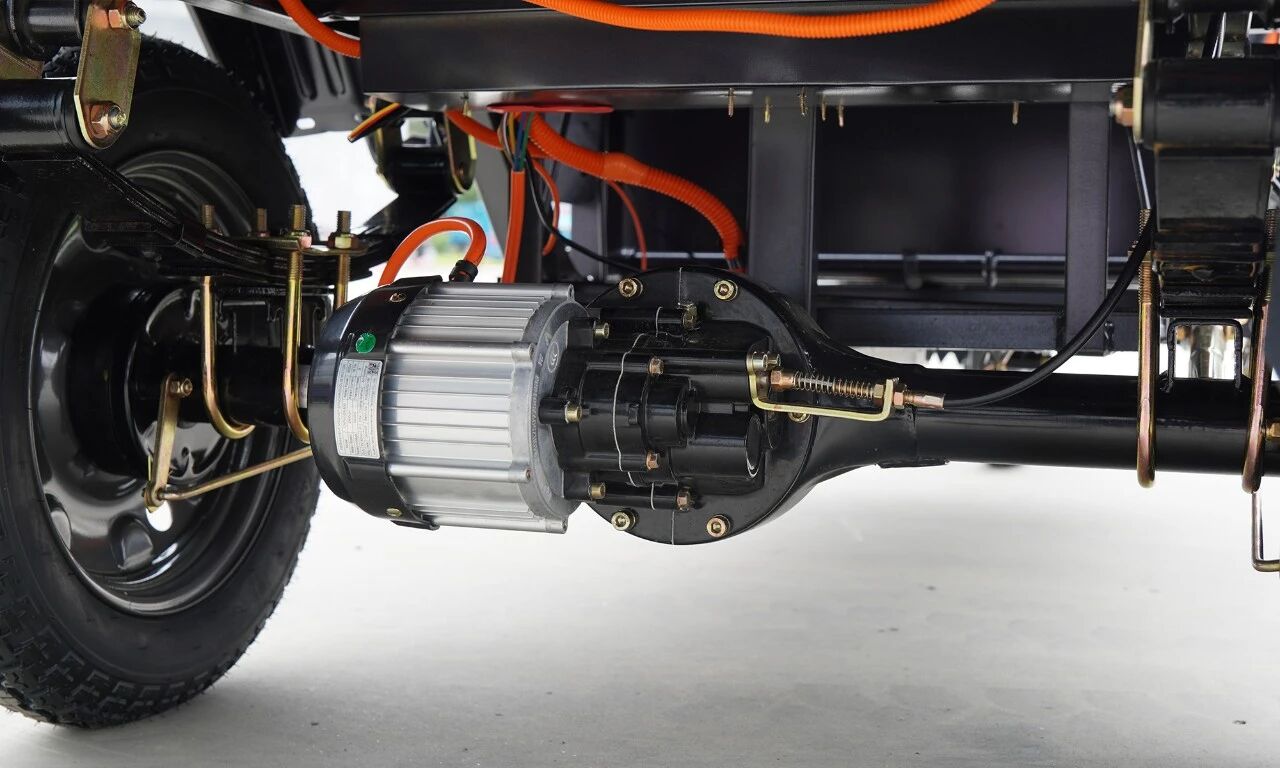
- Controller and Power System Motor torque determines starting and climbing ability, but actual output is influenced by controller peak current, rear-axle gear ratio, and high/low-speed design. In standard three-wheelers, insufficient controller or rear-axle design under full load may result in slow starts, poor climbing performance, or even motor overheating.
Our Optimization Solutions
- Frame: Dual-layer, dual-beam split frame with additional steel plate reinforcement, significantly enhancing rigidity and torsional resistance, keeping the vehicle stable and deformation-free under full load.
- Suspension and Tires: Optimized suspension and higher load-rated tires maintain balance and stability even at 800kg full load, ensuring safety and comfort.
- Controller: 30-tube dual-row permanent magnet synchronous controller with hill-hold function, ensuring safe torque output during starts or on slopes.
- Power System: Rear axle with 160-tooth integrated high/low-speed design, maintaining proper torque under varying loads and road conditions, improving climbing and acceleration performance.
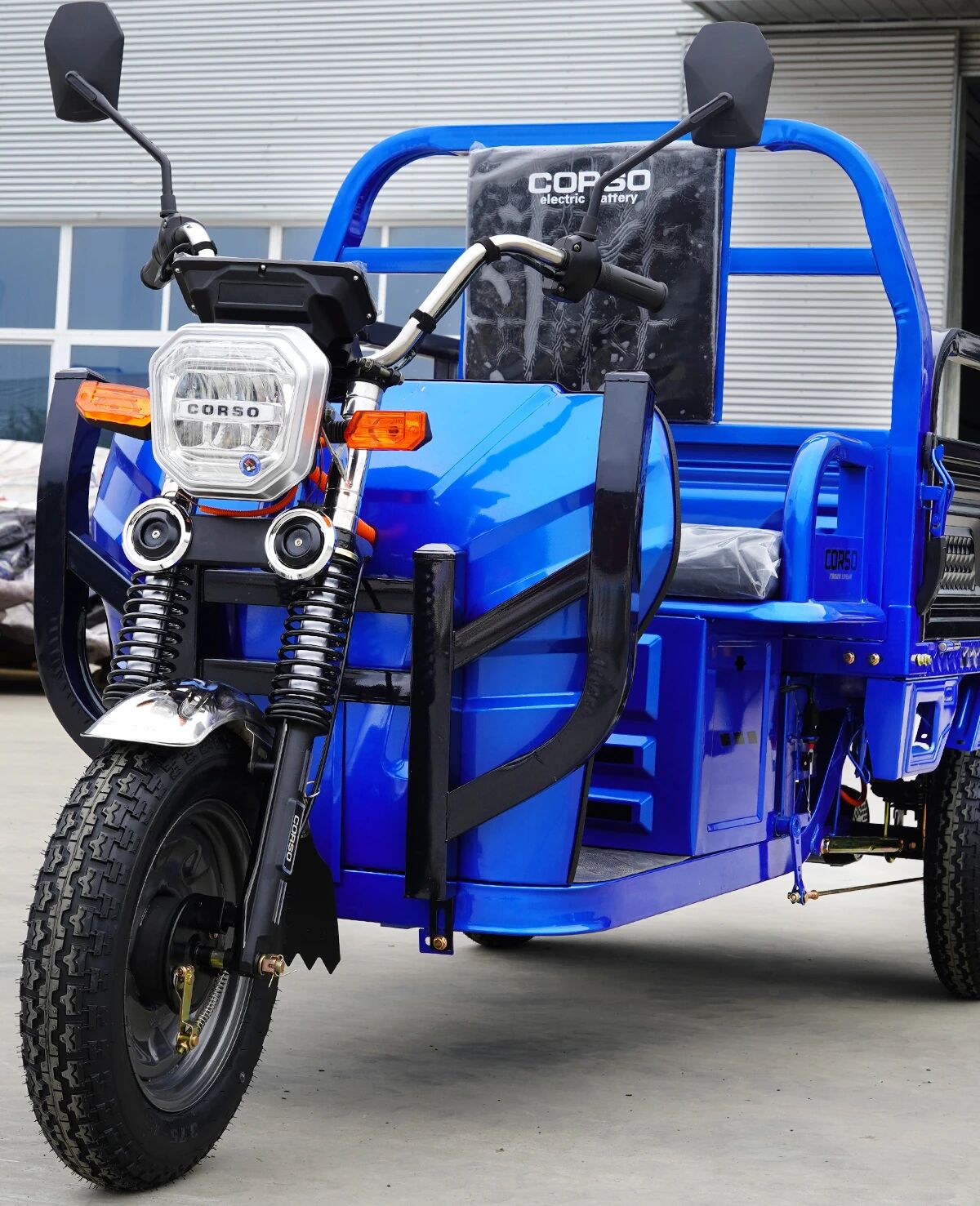
Through these system-level optimizations, our EEC models (2000W motors) and other 1.7m/1.8m models (1500W motors) can safely carry 800kg, balancing power, stability, and durability. This provides reliable performance for urban-rural logistics, sanitation operations, and short-distance transport.
6. Overview of Electric Three-Wheeler Configurations by Region
6.1 European Market
- Motor Power: In Europe, electric three-wheelers, especially for urban cargo or light-duty transport, commonly use motors in the 1,000–1,500 W range. Studies show that “Up to 1,000 W” and “1,000–1,500 W” are the mainstream segments. Although models above 1,500 W are increasing, they are primarily used for heavier loads or high-performance applications.
- Battery Type: LiFePO₄ (lithium iron phosphate) or Li-ion batteries dominate due to their safety, long lifespan, and high energy density, making them suitable for commercial vehicles with frequent use and long-term durability requirements.
- Design Features: European models emphasize stability, comfort, and overall vehicle quality, including reinforced frames, optimized suspension systems, and comprehensive braking and safety features.
Reasons:
- Regulatory restrictions: Europe has strict standards for power, speed, and safety of electric vehicles and three-wheelers; in some countries, the maximum motor power limit is around 4 kW.
- Usage scenarios: Mostly urban delivery, micro-logistics, or restricted areas, requiring moderate power, reliable range, and easy maintenance.
- Infrastructure: Well-developed charging stations, service networks, and battery replacement facilities make mid-power lithium battery solutions feasible.
6.2 Middle East & Central Asia Market
- Motor Power: Three-wheelers in these regions are often used for complex terrain, rural transport, or heavy loads, commonly equipped with 1,000–2,000 W motors to meet high load, hill-climbing, and continuous operation demands.
- Battery Type: Lithium batteries are gradually gaining adoption, but lead-acid batteries still hold a significant market share due to ease of charging/swapping, service network coverage, and high-temperature tolerance.
- Design Features: Vehicles are designed for durability and adaptability, with emphasis on frame structure, weather resistance, and maintenance convenience.
Reasons:
- Climate: High temperatures can affect lithium battery performance and safety, leading some users to prefer lead-acid batteries.
- Terrain and usage: Rural and mountainous conditions require frequent load-bearing starts and climbs, necessitating higher motor power.
- Infrastructure: Charging and battery-swapping networks are less developed than in Europe, so battery and motor choices prioritize reliability and durability over lightweight high performance.
6.3 Southeast Asia Market
- Motor Power: Commonly 1,000–3,000 W, with 1–2 kW most prevalent for urban delivery, light cargo, and rural transport. High-end or heavy-duty models may have higher power.
- Battery Type: Lead-acid batteries still occupy a large share, but lithium adoption is growing rapidly. Lithium batteries provide longer range, longer lifespan, and fewer replacements; lead-acid batteries are preferred for easier maintenance and compatibility with local infrastructure and usage habits.
- Design Features: Focused on practicality, cost control, and ease of replacement, suitable for mixed urban and rural scenarios.
Reasons:
- Replacement and maintenance convenience: Lead-acid batteries have a more developed replacement network and easier maintenance.
- Transport and regulations: Lithium batteries perform well, but transportation, customs, and hazardous materials procedures are more complex.
- Usage diversity: Short-distance delivery and low-speed rural operations do not require high motor power.
Overall Conclusion
The motor power and battery type configuration of electric three-wheelers in different regions is influenced by geography, climate, infrastructure, regulatory standards, usage scenarios, and maintenance networks:
- Europe: Prefers mid-power (1–1.5 kW) lithium batteries, emphasizing stability, efficiency, and regulatory compliance.
- Middle East / Central Asia: Load requirements and environmental factors push motor power higher, but battery choices are influenced by high temperatures and service network limitations.
- Southeast Asia: Motor power is increasing, but battery selection considers replacement convenience, transportation, and maintenance systems.
Key Takeaway: When purching products to different regions, it is important not to assume “higher motor power is always better” or “lithium batteries are mandatory.” Configurations should be scientifically matched according to regional demand, regulatory environment, and local usage habits.
Region | Common Motor Power Range | Main Battery Type | Design & Usage Characteristics | Key Influencing Factors & Analysis |
Europe | 1,000 – 1,500 W (some high-load models up to 2,000 W) | Mainly lithium (Li-ion / LiFePO₄) | Focus on stability, comfort, and safety; reinforced frame, optimized suspension, high overall build quality | ▪ Regulations limit motor power and speed (some countries ≤4 kW)▪ Mainly used for urban delivery and short-distance cargo▪ Well-developed charging infrastructure, suitable for mid-to-high power lithium batteries▪ Policies encourage green transport and low-emission vehicles |
Middle East & Central Asia | 1,000 – 2,000 W | Mixed lead-acid and lithium (high-end models mostly lithium) | Emphasis on durability and high-temperature adaptability; robust vehicle structure | ▪ High temperatures create additional safety requirements for lithium batteries▪ Mountainous and unpaved roads demand higher torque▪ Maintenance networks are still mainly lead-acid based▪ Governments gradually promote electric vehicles to replace fuel-powered vehicles |
Southeast Asia | 1,000 – 3,000 W | Lead-acid dominant (~60–70%), lithium growing rapidly (~30–40% in some regions) | Practical and cost-effective; simplified vehicle structure, easy to maintain | ▪ Diverse use cases: urban delivery, rural transport, low-speed short trips▪ Lead-acid batteries are easier to procure and maintain▪ Lithium batteries face transport and customs restrictions▪ Charging infrastructure is limited in some areas |
Africa | 800 – 2,000 W | Mainly lead-acid, lithium gradually increasing | Focus on load capacity and durability; reinforced suspension and frame | ▪ Cost and ease of maintenance drive battery choice▪ Limited infrastructure, charging not widely available▪ Transport and after-sales support limit lithium adoption |
Latin America | 1,000 – 2,000 W | Lithium gradually spreading, some still using lead-acid | Commonly used for urban logistics and farm transport; balances performance and durability | ▪ Government subsidies encourage lithium adoption▪ Diverse terrain and climate conditions▪ Import policies, tariffs, and transport convenience affect configuration choices |
Summary & Insights
- Motor Power Variations: Differences in motor power across regions mainly reflect road conditions, regulatory limits, and load requirements. Developed markets prioritize “regulatory compliance and performance balance,” whereas emerging markets focus on “durability and maintenance convenience.”
- Battery Type Differentiation: Market selection has gradually shifted from being “cost-driven” to “driven by environmental adaptability and operational convenience.” Key decision factors include temperature tolerance, transport regulations, and infrastructure availability.
- Future Trends: With improvements in lithium battery safety, optimized transport and customs regulations, and declining costs, lithium battery penetration in the Middle East, Africa, and Southeast Asia is expected to continue rising. Simultaneously, motor power ranges are likely to increase steadily to meet evolving application demands.
This report analyzed the design and application patterns of electric three-wheelers from multiple dimensions, including motor power, battery type, vehicle load capacity, and regional configuration differences. Key findings include:
- Motor-Battery Matching is Crucial: Proper matching ensures optimal range, performance, and battery life, while mismatched configurations can reduce efficiency, increase costs, and pose safety risks.
- Usage Scenarios Determine Configuration Priorities: Short-distance light loads, medium-distance medium loads, and long-distance heavy loads correspond to specific motor power and battery capacity combinations.
- Regional Market Differences are Significant: European markets prioritize regulatory compliance and performance balance, Middle East/Central Asia markets favor durability and high power, while Southeast Asia, Africa, and Latin America emphasize cost-effectiveness, load capacity, and maintenance convenience.
- Future Trends: With declining costs and improved safety of lithium batteries, global markets are expected to shift toward higher-performance lithium configurations, while motor power ranges will steadily increase to meet more demanding transport and load requirements.
Overall, scientifically matching motors and batteries, combined with vehicle design optimization and regional considerations, is key to enhancing electric three-wheelers’ overall performance, reducing total cost of ownership (TCO), and meeting diverse market needs.