
Buyer Decision CenterBuyer Decision Center
2026年5月28日
How to Evaluate Battery and Motor Quality in Commercial Electric Cargo Tricycles for European Fleets
Learn how to evaluate battery and motor quality in commercial electric cargo tricycles for European fleet operations, last-mile delivery, and agri-logistics applications.
How to Evaluate Battery and Motor Quality in Commercial Electric Cargo Tricycles for European Fleets
As fuel prices, labor costs, and urban access restrictions continue to reshape logistics and agricultural operations across Europe, more fleet operators are evaluating commercial electric cargo tricycles (L2e-U) as a practical transport solution.
However, one challenge appears repeatedly in the market:
On paper, many electric cargo tricycles look similar.
In real fleet operations, the reliability gap becomes obvious very quickly.
For distributors, fleet managers, and procurement teams, the biggest long-term risks are usually not visible in the product photos or specification sheets. In most cases, battery quality and motor configuration determine whether a vehicle becomes a reliable commercial asset—or an expensive after-sales problem.
This guide explains several common procurement risks European buyers should pay attention to before importing or deploying electric cargo trikes for commercial use.
Why Battery and Motor Quality Matter in European Fleet Operations
Commercial electric tricycles operating in Europe often face demanding working conditions:
- Frequent stop-start driving
- Heavy payload transport
- Cold winter temperatures
- Narrow urban streets
- Steep slopes in agricultural regions
- Long daily operating hours
Under these conditions, low-quality batteries and under-configured motors tend to fail much earlier than expected.
For fleet operators, the real cost is rarely the purchase price alone.
The larger risk comes from:
downtime,warranty claims,replacement logistics,local repair labor,and operational interruptions.
This is why Total Cost of Ownership (TCO) matters far more than initial procurement cost.
Common Battery Problems in Low-Cost Electric Cargo Tricycles
1. Inconsistent Battery Cell Quality
One of the most common issues in low-cost electric utility vehicles is inconsistent battery cell quality.
Some suppliers may use cells with poor cycle consistency or unstable internal resistance in order to reduce production costs.
While the battery label may still display the expected voltage and capacity, real-world fleet performance can become unstable under:
- heavy payloads,
- cold weather,
- or continuous commercial usage.
Over time, this may lead to:
- reduced driving range,
- faster capacity degradation,
- overheating risks,
- and increased after-sales replacement rates.
2. Range Claims Based on Unrealistic Conditions
Many advertised range figures are tested under ideal conditions:
- empty vehicle,
- flat roads,
- warm temperatures,
- low average speed.
Real European fleet operations are very different.
For commercial use, buyers should evaluate battery range under:
- full payload conditions,
- winter temperatures,
- urban stop-start cycles,
- and actual delivery routes.
In practice, experienced fleet buyers often calculate real operational range significantly below showroom test figures.
3. Weak Battery Management Systems (BMS)
Battery Management Systems (BMS) play a critical role in protecting lithium battery packs.
A poorly designed BMS may fail to:
- balance cells correctly,
- manage charging temperatures,
- prevent over-discharge,
- or protect against abnormal current loads.
For commercial fleet applications, stable BMS protection is often more important than headline battery capacity.
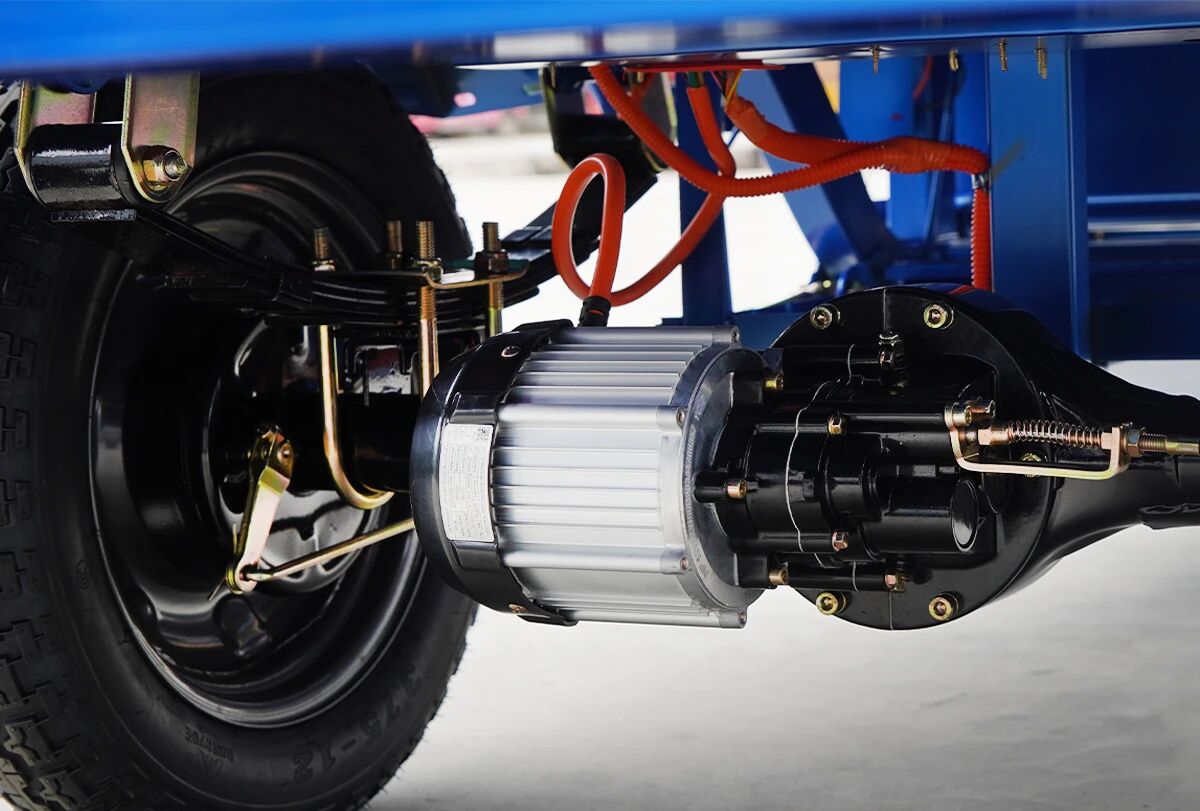
How to Evaluate Motor Reliability for Heavy-Duty Commercial Use
Rated Power vs Peak Power
One common procurement mistake is focusing only on peak motor power.
In commercial logistics and agricultural transport, continuous rated power is far more important.
Why?
Because fleet vehicles rarely operate in short bursts.
They operate under sustained load conditions:
- climbing slopes,
- carrying cargo,
- frequent acceleration,
- and continuous daily operation.
An under-configured motor may perform well briefly but overheat under long-term commercial workloads.
Stop-Start Urban Delivery Creates High Thermal Stress
Last-mile delivery fleets in Europe often operate in dense urban environments with:
- constant braking,
- repeated acceleration,
- narrow streets,
- and high traffic density.
This creates continuous thermal stress on:motors,controllers,and drivetrain components.
Without proper cooling and load matching, long-term reliability drops significantly.
Real-World Testing Matters More Than Brochure Specifications
Before procurement, buyers should request testing based on actual working conditions rather than ideal laboratory scenarios.
Examples include:
- full payload driving,
- slope climbing under load,
- repeated stop-start operation,
- and extended low-speed delivery routes.
For commercial EV fleets, operational durability matters more than theoretical specifications.
Procurement Checklist for European Buyers
Before placing an order for commercial electric cargo tricycles, buyers should verify:
Battery System
- Cell manufacturer traceability
- Battery cycle life data
- UN38.3 and transport certifications
- Battery warranty terms
- BMS protection functions
Motor & Drivetrain
- Continuous rated power
- Cooling design
- Controller matching
- Payload suitability
- Performance under slope conditions
Vehicle Structure
- Chassis strength
- Corrosion protection
- Suspension durability
- Brake system configuration
- Long-term maintenance accessibility
Typical European Application Scenarios
Agri-Logistics
Used in:greenhouses,vineyards,nurseries,and farm transport operations.
Key requirements:
- low-speed torque,
- stable payload handling,
- and reliability on uneven terrain.
Last-Mile Delivery
Used for:urban parcel distribution,food delivery,industrial parks,and campus logistics.
Key requirements:stop-start efficiency,low operating cost,and maneuverability in narrow streets.
Facility & Municipal Operations
Used in:resorts,warehouses,airports,and closed campuses.
Key requirements:
- quiet operation,
- low maintenance,
- and high operational safety.
Final Thoughts: TCO Matters More Than Purchase Price
For European fleet operators and distributors, the cheapest vehicle is not always the most economical vehicle.
In commercial operations, low purchase prices can quickly be offset by:downtime,maintenance costs,replacement parts,and customer dissatisfaction.
A commercial electric cargo tricycle should be evaluated based on:
- long-term durability,
- operational suitability,
- and reliability under real working conditions.
In many cases, selecting the right specification for the actual workload is more important than minimizing upfront cost.
Frequently Asked Questions (FAQ)
What battery type is best for commercial electric cargo tricycles?
Lithium battery systems with stable BMS protection and verified cycle consistency are generally preferred for commercial fleet operations.
What should European distributors check before importing electric cargo trikes?
Buyers should verify:certifications,battery traceability,motor rated power,corrosion protection,and after-sales support capability.
Why do some electric cargo tricycles lose performance under heavy load?
This is often related to under-configured motors, insufficient cooling systems, or drivetrain designs not optimized for continuous heavy-duty commercial use.
What matters more: peak motor power or rated power?
For commercial applications, continuous rated power is usually more important because fleet vehicles operate under sustained daily workloads rather than short bursts of acceleration.
Related Topics
How to Prevent Chassis Corrosion in Coastal Logistics Environments
Electric Cargo Tricycles for European Last-Mile Delivery
How to Evaluate TCO in Commercial EV Fleets
Choosing the Right Electric Utility Vehicle for Agricultural Transport