
Sep 27, 2026Risk & Compliance
Electric Cargo Tricycles in Germany 2026: A B2B Buyer’s Guide to L2e-U Utility Vehicles
Discover how L2e-U electric cargo tricycles fit into the German B2B market. This guide explains the differences between E-Cargo Bikes, L2e-U and L5e-B vehicles, their applications in logistics, indust
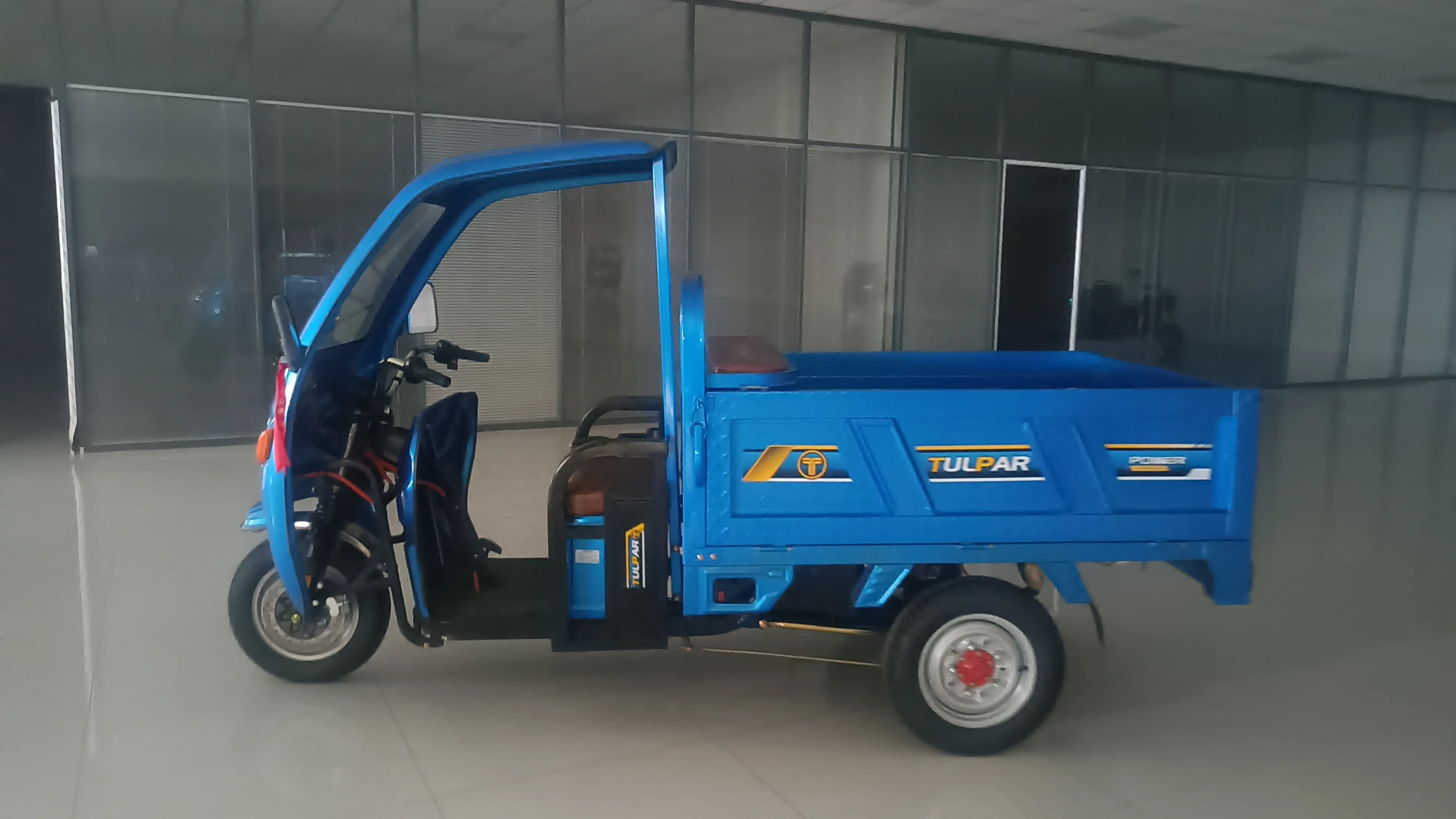
Electric Cargo Tricycles in Germany 2026: A B2B Buyer’s Guide to L2e-U Utility Vehicles
Last Updated: September 2026
Germany offers a wide range of applications for compact electric commercial vehicles, from local delivery and facility management to industrial intralogistics and municipal services.
For B2B buyers, however, choosing an electric cargo tricycle is not simply a question of motor power or cargo capacity.
The key questions are:
What vehicle category is it? Is the configuration approved for the EU market? What documents are provided? And can it be used legally and economically for the intended operation in Germany?
This guide focuses on L2e-U electric cargo tricycles and the key issues German distributors, fleet operators and commercial buyers should consider when sourcing from China.
Table of Contents
Electric Cargo Tricycles in Germany 2026: A B2B Buyer’s Guide to L2e-U Utility Vehicles
1. Where Does an L2e-U Fit in Germany?
2. What Makes a Vehicle L2e-U?
3. E-Cargo Bike vs. L2e-U vs. L5e-B Electric Cargo Vehicles
4. Where Can L2e-U Electric Cargo Tricycles Be Used?
5. Driving Licence Requirements in Germany
6. Insurance, Registration and Vehicle Documents
7. EU Type Approval and CoC: What Should Buyers Check?
8. B2B Applications: What Should Buyers Evaluate?
9.CKD and SKD for European B2B Projects
10. Frequently Asked Questions
Conclusion
Quick Answer
An L2e-U is a utility subcategory within the EU L2e three-wheel moped category.
Under Regulation (EU) No 168/2013, the L2e framework includes key limits such as:
Parameter | L2e |
Vehicle type | Three-wheel moped |
Maximum design speed | 45 km/h |
Maximum continuous rated/net power | 4 kW |
Mass in running order | 270 kg, subject to regulatory definitions |
Seating | Maximum 2 |
L2e-U purpose | Goods transport |
L2e-U vehicles should therefore be evaluated as motor vehicles, rather than simply as large electric cargo bikes. Consequently, at its core, it is a compact, low-speed, and appropriately load-rated urban freight tool — a tool that falls squarely within the regulatory scope of light motor vehicles.
1. Where Does an L2e-U Fit in Germany?
The German market includes several types of electric cargo vehicles.
Vehicle | Typical characteristics | Main consideration |
E-cargo bike | Pedal-assisted, bicycle-oriented | Bicycle infrastructure and urban delivery |
L2e-U tricycle | Three-wheel motor vehicle, up to 45 km/h | Type approval and motor-vehicle rules |
Small electric van | Larger capacity and higher operating cost | Higher transport volume |
Industrial electric utility vehicle | Often used on private sites | Site-specific requirements |
An L2e-U can therefore occupy a useful position between an e-cargo bike and a conventional commercial vehicle.
The right choice depends on the operating environment, route, cargo requirements and regulatory framework.
2. What Makes a Vehicle L2e-U?
The fact that a vehicle has three wheels, an electric motor and a cargo box does not by itself make it an L2e-U.
The vehicle must meet the applicable requirements of the EU L-category framework.
L2e-U at a glance
- Utility subcategory: designed for goods transport
- Electric powertrain: electric propulsion
- Maximum design speed: 45 km/h
- Power limit: up to 4 kW continuous rated/net power
- EU approval: subject to the applicable type-approval framework
- Vehicle identification: VIN and relevant documentation
- Conformity: CoC for vehicles covered by the applicable approval framework
For a professional buyer, the type approval documentation should take priority over the marketing description.
3. E-Cargo Bike vs. L2e-U vs. L5e-B Electric Cargo Vehicles
For European B2B buyers, an electric cargo tricycle is not defined only by its appearance. The same three-wheeled vehicle can fall into very different regulatory and commercial categories depending on its design, mass, speed, power and intended use.
For Germany, three categories are particularly useful to distinguish:
- E-Cargo Bike – generally positioned within the bicycle/e-bike framework
- L2e-U – a light three-wheeled motor vehicle designed for utility and goods transport
- L5e-B – a heavier commercial tricycle category designed for more demanding commercial transport applications
The distinction matters because the regulatory category affects not only road use, but also the vehicle's engineering scope, payload potential and suitable business applications.
3.1 The Basic Difference
| E-Cargo Bike | L2e-U | L5e-B |
Basic concept | Cargo bicycle / e-bike | Light utility three-wheeler | Commercial tricycle |
Main purpose | Light cargo and urban mobility | Light commercial and utility transport | More demanding commercial goods transport |
Maximum design speed | Bicycle/e-bike framework | ≤45 km/h | Higher vehicle design scope |
Mass framework | Bicycle/e-bike rules | ≤270 kg mass in running order | ≤1,000 kg mass in running order |
Typical transport task | Small, light loads | Light loads over short distances | Medium/heavier commercial loads |
Typical environment | Urban streets, bike-compatible routes | Urban roads, industrial sites, facilities | Commercial and industrial transport |
Commercial intensity | Light | Light to moderate | Moderate to high |
The important point is that L2e-U sits between an E-Cargo Bike and a heavier commercial tricycle.
It is not simply a larger cargo bike, but it is also not intended to cover every heavy-duty transport task.
3.2 What Makes L2e-U Different?
Under EU Regulation 168/2013, L2e is divided into different subcategories, including L2e-P for passenger-oriented use and L2e-U for utility purposes.
L2e-U is specifically intended for goods transport and is designed with a dedicated cargo area.
The L2e framework also establishes important limits, including:
- Maximum design speed of 45 km/h
- Maximum continuous rated power of 4 kW
- Mass in running order of no more than 270 kg
- Maximum of two seats
- Utility-oriented design for L2e-U
These limits define the fundamental character of an L2e-U:
A light, low-speed motor vehicle for short-distance utility and goods transport.
This is why an L2e-U should not automatically be evaluated against a conventional light commercial vehicle or a heavy-duty cargo tricycle.
The more useful question is:
What transport task is the vehicle actually expected to perform?
3.3 Where L2e-U Makes Sense
L2e-U can be a practical solution when the customer needs a motorized cargo vehicle but does not need the mass, dimensions or transport capacity of a larger commercial vehicle.
Typical applications include:
- Local last-mile delivery
- Small parcel delivery
- Facility management
- Maintenance and service operations
- Landscaping and gardening
- Hotel and resort operations
- Internal logistics
- Short-distance transport within industrial or commercial sites
- Small businesses and service companies
For these applications, the value of the vehicle is often not maximum payload.
Instead, customers may value:
compact dimensions + low-speed operation + maneuverability + lower operating cost + easy access to short-distance routes
This is particularly relevant in industrial sites, warehouses, logistics parks and other controlled environments where repetitive short-distance transport is more important than long-distance road freight.
3.4 Why L5e-B Is a Different Commercial Segment
L5e-B belongs to a different vehicle class.
Under the EU L-category framework, L5e includes commercial tricycles, and the mass framework is substantially larger than that of L2e.
A simplified comparison is:
L2e: ≤270 kg mass in running order
L5e: ≤1,000 kg mass in running order
This does not mean that every L5e-B vehicle can legally carry 700 kg or 1,000 kg of cargo.
The actual legal payload still depends on the individual vehicle's approved technical parameters, including:
- Technically permissible maximum laden mass
- Axle loads
- Vehicle curb/running mass
- Homologated configuration
- Approved payload or corresponding mass calculation
However, the L5e framework provides considerably more engineering space for a vehicle designed for intensive commercial transport.
This makes L5e-B more suitable for applications involving:
- Larger cargo bodies
- Heavier equipment
- Higher payload requirements
- More intensive commercial transport
- Industrial goods movement
- Professional logistics operations
In other words, L5e-B is not simply a faster L2e-U. It represents a different commercial vehicle positioning.
3.5 Choose by Transport Task, Not Simply by Customer Size
It is tempting to describe the difference as:
L2e-U = small customers
L5e-B = large customers
That is too simplistic.
A better approach is to classify the vehicle according to the transport task.
Transport requirement | L2e-U | L5e-B |
Short-distance urban transport | ★★★★★ | ★★★★ |
Small businesses / service companies | ★★★★★ | ★★★★ |
Small parcel delivery | ★★★★★ | ★★★★ |
Internal site logistics | ★★★★★ | ★★★★★ |
Light industrial transport | ★★★★ | ★★★★★ |
Professional logistics operations | ★★★ | ★★★★★ |
Frequent heavy-load transport | ★★ | ★★★★★ |
Larger cargo body / equipment | Limited | More suitable |
High payload requirement | Limited by L2e mass framework | More suitable, subject to homologated parameters |
The dividing line is therefore not simply company size.
A large industrial company may have many short-distance, light-load transport tasks that are well suited to L2e-U.
Conversely, even a small logistics company may require an L5e-B vehicle if its daily operation involves heavier loads or more demanding commercial transport.
3.6 The Practical Position of L2e-U
For a German B2B buyer, the simplest way to understand the three categories is:
E-Cargo Bike
→ bicycle-based solution for relatively light cargo and urban mobility
L2e-U
→ light motorized utility vehicle for short-distance commercial and internal goods transport
L5e-B
→ heavier commercial tricycle for more demanding transport requirements
Therefore, an L2e-U should not be marketed simply as a “small electric truck.”
A more accurate positioning is:
A compact electric utility vehicle for light commercial transport and repetitive short-distance logistics tasks.
This distinction is important when evaluating an electric cargo tricycle for the German market. The right question is not simply “How much can it carry?”, but rather:
“What transport task is it legally and technically designed to perform?”
That question provides a much more reliable starting point for evaluating whether an L2e-U is suitable for a particular B2B operation.
4. Where Can L2e-U Electric Cargo Tricycles Be Used?
Once the vehicle category is understood, the next question is more practical:
Where does an L2e-U actually make commercial sense in Germany?
The answer is not simply “delivery” or “logistics.”
Germany has a dense network of manufacturing clusters, logistics hubs, industrial estates and commercial sites. Many of these environments generate a specific type of transport requirement: small or medium loads moved repeatedly over relatively short distances.
That is where an L2e-U can potentially complement — rather than replace — conventional vans, trucks and forklifts.
4.1 Automotive & Industrial Logistics — Stuttgart Region
The Stuttgart Region is one of Germany's major automotive and industrial clusters, with vehicle manufacturers, component suppliers, engineering companies and numerous medium-sized industrial businesses operating within a relatively concentrated economic area.
This industrial structure creates many short-distance transport tasks that do not necessarily require a conventional van or truck.
Typical examples include:
- Moving components from a warehouse to a production area
- Delivering tools and spare parts between workshops
- Transporting packaging materials
- Supporting maintenance teams
- Moving samples or urgent small shipments between nearby facilities
- Internal transport between different buildings or production areas
For these operations, the vehicle's value is not necessarily maximum range or maximum speed.
The more relevant factors may be:
Compact dimensions + dedicated cargo space + frequent availability + low operating cost + suitability for repetitive short-distance movement
In this context, an L2e-U can be viewed not simply as a delivery tricycle, but as a small industrial utility vehicle supporting day-to-day plant and supplier logistics.
4.2 Logistics & Industrial Operations — Rhine-Ruhr
The Rhine-Ruhr region presents a different but equally relevant environment.
The region combines industrial estates, warehouses, distribution centres, logistics facilities and major transport infrastructure. The wider Rhine-Ruhr area also includes the Duisburg logistics and inland-port cluster, creating a particularly strong environment for freight-related operations.
Here, the potential role of an L2e-U is often not long-distance transportation.
Instead, it can support the short-distance links within a larger logistics process.
Potential applications include:
- Warehouse-to-warehouse movements
- Picking and replenishment
- Spare-parts transportation
- Maintenance and facility-service operations
- Transport between logistics buildings
- Industrial-site support
- Small-load movements around distribution facilities
- Service operations around ports and logistics sites
A logistics company may continue to use trucks for the main freight movement while using smaller electric utility vehicles for repetitive movements within a site or local operating area.
In other words:Truck for the main transport → L2e-U for selected short-distance operational tasks.
This is an important way to evaluate the vehicle commercially.
4.3 Urban Delivery and Commercial Services
Germany's urban logistics environment creates another potential application.
In cities such as Stuttgart, commercial operators are increasingly dealing with questions around delivery traffic, congestion, limited urban space and the organisation of last-mile logistics.
Potential applications include:
- Parcel and courier operations
- Local business deliveries
- Hotel and catering supply
- Retail replenishment
- Campus logistics
- Commercial-site deliveries
- Local facility services
However, buyers should not assume that an L2e-U can use bicycle infrastructure simply because it is smaller than a van.
An L2e-U is a motor vehicle, and its road-use rights should therefore be evaluated according to its actual legal classification and the applicable German traffic rules.
This distinction is particularly important when a project is designed around urban delivery routes.
4.4 Facility Management and Technical Services
Not all commercial transport involves delivering products to customers.
Large industrial sites, commercial properties, hospitals, universities, hotels and exhibition centres can also require frequent movement of equipment and materials.
Typical tasks include:
- Maintenance tools
- Cleaning equipment
- Spare parts
- Building-service equipment
- Grounds-maintenance tools
- Waste-collection support
- Internal deliveries between buildings
- Technical-service operations
In these environments, an L2e-U may spend much of its working time within a defined commercial or industrial area.
The key value is often not maximum carrying capacity, but availability and efficiency for repetitive service movements.
Instead of sending a full-size van whenever a technician needs to move tools or equipment across a site, a compact electric utility vehicle may provide a more appropriately sized transport solution.
4.5 Municipal, Landscaping and Horticultural Operations
L2e-U vehicles may also be considered for municipal and outdoor service operations where compact transport equipment is required.
Potential applications include:
- Park and green-space maintenance
- Landscaping
- Cemetery maintenance
- Property maintenance
- Horticultural operations
- Municipal service work
- Transport of tools, plants and materials
The suitability of the vehicle depends heavily on the actual operating environment.
For example, a project involving mainly private-site operation may have different requirements from one involving regular public-road travel.
Terrain, cargo requirements, daily distance, loading frequency and local operating rules should therefore be considered before selecting the vehicle.
4.6 What Kind of Operation Creates the Strongest Business Case?
Looking across these applications, the strongest business case is not necessarily tied to one particular industry.
Instead, look for a repetitive transport task with a specific operating pattern:
Operating characteristic | Why it may favour an L2e-U |
Frequent short-distance trips | The vehicle can be used repeatedly throughout the working day |
Multiple trips per shift | High utilisation can improve the economics of a dedicated vehicle |
Industrial or commercial site | Compact dimensions can be useful |
Small or medium loads | A full-size van may be unnecessarily large for some tasks |
Frequent stop-and-go operation | An electric drivetrain can be advantageous |
Repetitive local deliveries | The vehicle can be dedicated to a predictable route |
Need for enclosed or dedicated cargo space | Provides more structured cargo transport than a conventional bicycle |
Maintenance or service work | Cargo space can carry tools and equipment |
Mixed private-site and local-road operation | A road-legal utility vehicle may provide greater operational flexibility |
The key question for a German B2B buyer is therefore not simply:
“Can this vehicle carry cargo?”
A more useful question is:
“Which repetitive transport task currently requires a van, truck, forklift or manual handling, but actually involves relatively short distances and small-to-medium loads?”
If such a task exists, an L2e-U may be worth evaluating as a dedicated electric utility vehicle.The objective is not necessarily to replace the company's existing transport fleet.It may simply be to use the right-sized vehicle for the right transport task.That is often where the commercial case for an L2e-U becomes clearer.
5. Driving Licence Requirements in Germany
L2e vehicles fall within the German AM licence category.
German law also contains provisions allowing Class B licence holders to operate three-wheeled motor vehicles in Germany.
For a commercial fleet, buyers should confirm the requirement based on:
- Vehicle category
- Driver's licence
- Driver circumstances
- Intended operation
The safest approach is to verify the specific case under the current German Fahrerlaubnis-Verordnung (FeV) rather than relying on a general statement such as “a car licence is always sufficient.”
6. Insurance, Registration and Vehicle Documents
One important distinction is:
Type approval, vehicle registration and insurance are different matters.
For relevant L-category vehicles, Germany uses an insurance-plate system for certain vehicles that are exempt from the conventional registration procedure.
For buyers, the practical documentation chain can be viewed as:
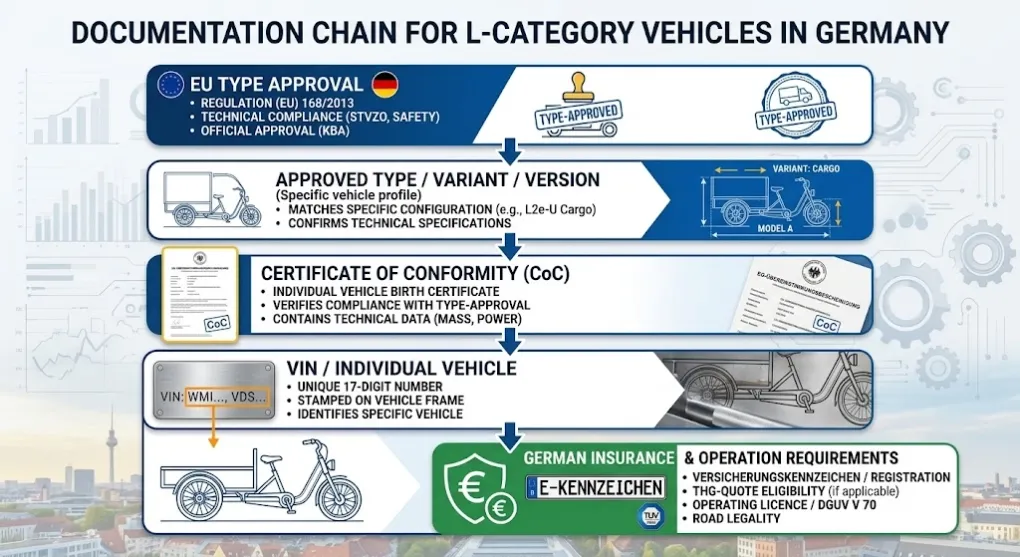
Before delivery, a German buyer should confirm the exact administrative requirements for the vehicle being imported.
7. EU Type Approval and CoC: What Should Buyers Check?
Simply hearing:“This vehicle has EEC certification?” is not enough for a professional B2B purchase.A buyer should verify:
Item | What to confirm |
Vehicle category | L2e-U |
Type approval | Approval reference/number |
Type | Exact approved type |
Variant/version | Exact configuration |
VIN | Vehicle identification |
CoC | Whether supplied for each vehicle |
Motor | Approved power specification |
Speed | Approved maximum design speed |
Mass parameters | Approved values |
Equipment | Corresponds to approved configuration |
The most important principle is:
The vehicle delivered to the customer should correspond to the approved configuration.
8. B2B Applications: What Should Buyers Evaluate?
For B2B buyers, the right electric cargo tricycle should be selected based on the transport task it is expected to perform, rather than on headline specifications alone.
Before comparing motor power, battery capacity or cargo-box size, buyers should first understand how the vehicle will actually be used.
The key questions are:
Question | Why it matters |
Where will the vehicle operate? | Public roads, industrial sites, warehouses, logistics parks and private facilities can involve very different operating requirements. |
How far does it need to travel? | Short, repetitive routes require a different vehicle solution from longer-distance delivery operations. |
What does it need to carry? | The type, weight and volume of the cargo determine whether a light utility vehicle is sufficient or a heavier commercial vehicle is more appropriate. |
How frequently will it transport cargo? | Occasional transport is very different from continuous, high-frequency commercial operation. |
What type of route will it use? | Flat urban routes, narrow internal roads, ramps, uneven surfaces and mixed-traffic roads can place different demands on the vehicle. |
How much cargo space is actually required? | Cargo volume can be just as important as payload when selecting the body and vehicle configuration. |
Does the vehicle need special equipment? | Refrigeration, tools, municipal equipment or other permanently installed equipment may affect the vehicle configuration and compliance assessment. |
What level of vehicle capacity does the operation really require? | The objective is to avoid both under-specifying and over-specifying the vehicle for the actual transport task. |
From Transport Task to Vehicle Class
These questions are important because not every cargo transport task requires the same type of vehicle.
A vehicle used for:short-distance internal logistics + light cargo + repetitive routes has a very different operating profile from one used for:frequent commercial delivery + heavier cargo + higher transport intensity.
The first application may benefit from a compact, lightweight utility vehicle with good maneuverability and low operating costs.
The second may require a vehicle with greater mass, payload and engineering capacity.This is why B2B buyers should not begin the selection process with:
“How powerful is the motor?”
A better starting point is:
“What transport task do we need the vehicle to perform?”
Once the application is clearly defined, buyers can then evaluate the vehicle's approved category, permissible mass, payload, dimensions, range, body configuration and other technical characteristics.
A useful way to approach the selection is:
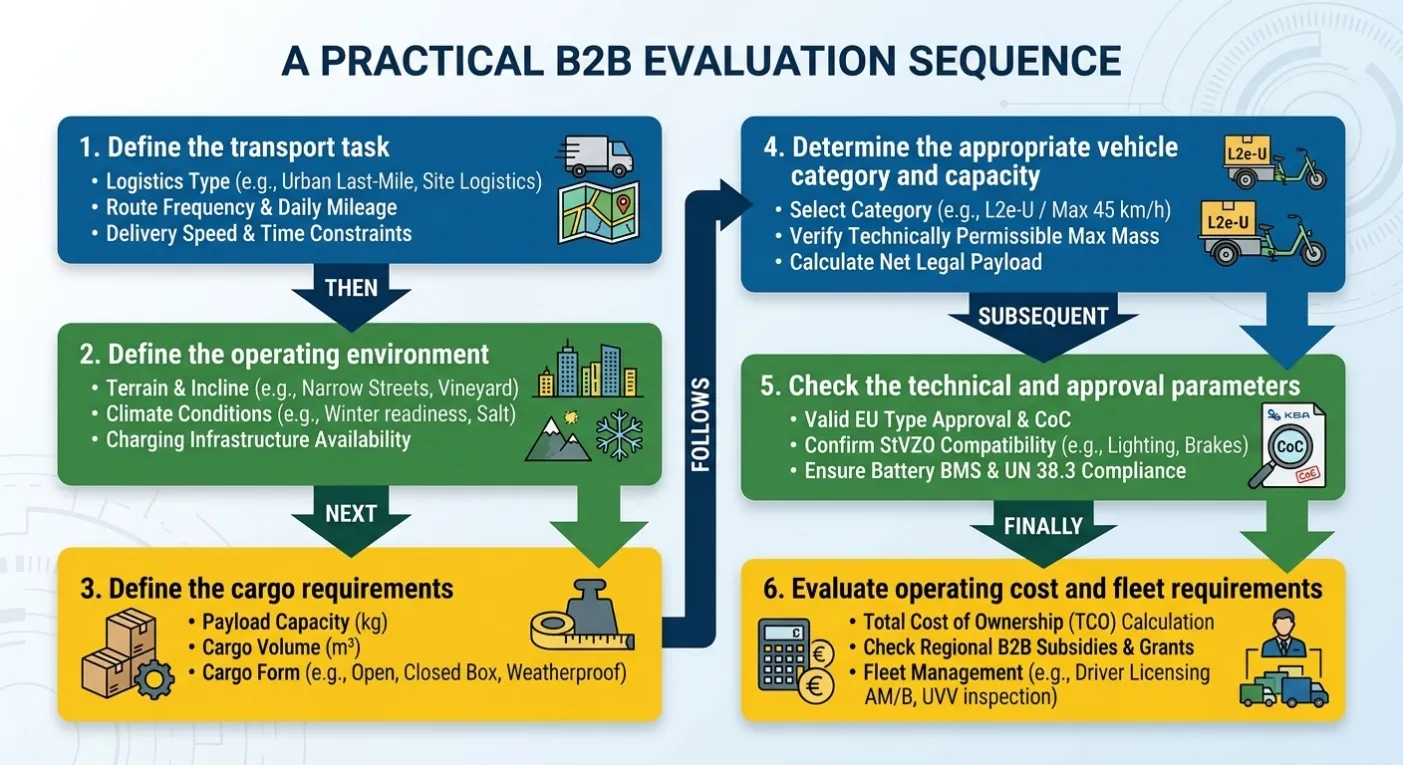
This approach helps prevent a common purchasing mistake: choosing a vehicle because its specifications look impressive, while its actual configuration does not match the intended application.
For commercial electric cargo tricycles, the best vehicle is not necessarily the one with the highest payload, largest battery or most powerful motor. It is the vehicle whose legal and technical characteristics are appropriately matched to the job it needs to perform.
10.CKD and SKD for European B2B Projects
For European B2B projects, we do not normally recommend shipping electric cargo tricycles as fully assembled CBU (Completely Built Unit) when container utilisation is a major consideration.
A fully assembled vehicle occupies more container space, while its three-wheel structure, cargo body and overall dimensions can make container loading and unloading less efficient.
For this reason, SKD or CKD can be considered depending on the customer's local capabilities and project requirements.
When Is SKD the Better Choice?
For most distributors and project customers without their own assembly facility, SKD is usually the more practical solution.
Our SKD configuration can be prepared so that the main vehicle is shipped largely assembled. After arrival, the customer only needs to complete a small number of straightforward assembly operations, such as:
- Installing the wheels
- Installing the cargo-box doors
Under normal conditions, one vehicle can be assembled in approximately 10 minutes once the customer is familiar with the procedure.This approach can provide a useful balance between:
better container utilisation + simple local assembly + lower technical requirements.
It is particularly suitable for:
- Distributors without a dedicated assembly line
- Small and medium-sized fleet projects
- Initial market-entry orders
- Customers who want to reduce shipping volume without taking on complex assembly work
- Projects where the customer wants to handle final preparation locally
At present, we do not have a dedicated European partner network specifically established for CKD assembly. Therefore, where the customer does not already have suitable assembly capability, we generally recommend SKD rather than full CKD.
When Does CKD Make More Sense?
CKD (Completely Knocked Down) involves a much higher level of disassembly and requires substantially more local assembly work.It may become attractive when the customer has:
- Its own workshop or assembly facility
- Qualified technicians
- Appropriate tools and equipment
- A reliable local quality-control process
- Sufficient annual volume to justify the investment
- A long-term plan for local assembly or localisation
For a distributor simply testing the market or placing relatively small orders, CKD can introduce unnecessary complexity.The customer needs to consider not only the saving in shipping volume, but also:
- Labour cost
- Assembly time
- Training
- Quality control
- Spare parts and assembly tools
- Responsibility for final assembly
- Local technical support
- Compliance implications
Therefore, CKD is not automatically more economical than SKD. Its value depends heavily on order volume and the customer's local capabilities.
SKD vs. CKD: Which One Should You Choose?
Situation | Recommended solution |
No local assembly capability | SKD |
Distributor entering the market | SKD |
Small or medium-sized project | SKD |
Simple final assembly is acceptable | SKD |
Customer has its own workshop | SKD or CKD |
Established assembly team | CKD can be considered |
Large and recurring project volume | CKD may become more attractive |
Long-term local assembly strategy | CKD |
Customer wants minimum local technical work | SKD |
The objective is therefore not simply to choose the most disassembled shipping format.The better approach is to find the right balance between container efficiency and local assembly complexity.
Compliance Still Applies
CKD and SKD should not be viewed as a way to avoid EU or national compliance requirements.The final vehicle must still correspond to the applicable technical and approval requirements for its intended market and configuration. The assembly process, components and final vehicle configuration should therefore be considered together with the relevant type-approval documentation.
For European projects, we normally recommend discussing the CBU/SKD/CKD configuration before placing the order, particularly when the customer has specific container-loading targets, local assembly plans or special vehicle configurations.
11. Frequently Asked Questions
Q:Can I drive an L2e-U with a Class B licence?
A:German law contains provisions allowing holders of a Class B driving licence to operate certain three-wheeled motor vehicles in Germany. L2e vehicles also fall within the AM licence category.
However, the applicable driving-licence requirement can depend on the specific vehicle and the driver's circumstances. Buyers should therefore confirm the requirements applicable to their individual situation before operating the vehicle on public roads.
Q: Can an L2e-U Be Modified After Import?
Yes, but modifications to an EEC-approved L2e-U should be assessed carefully, especially if the vehicle will be used on public roads after the modification.
B2B customers may want to adapt an L2e-U for specific applications by changing the cargo body, adding equipment or installing specialized systems. Whether a modification is acceptable depends on what is being changed and whether the resulting vehicle remains within the applicable approved configuration.
Common project modifications may include:
- Cargo boxes, doors and covers
- Tool systems
- Refrigeration equipment
- Municipal equipment
- Agricultural equipment
- Other permanently installed equipment
A vehicle being physically capable of accepting additional equipment does not necessarily mean that the modified configuration remains covered by the original approval.
Modifications involving areas such as the following may require particular attention:
- Vehicle dimensions
- Seating
- Braking system
- Lighting
- Battery system
- Motor or controller
- Cargo structure
- Permanently installed equipment
Q:What about changing from lead-acid to lithium batteries?
A:This is an important consideration for our EEC-certified models.
Our EEC-certified vehicle configurations use lead-acid batteries as the standard approved battery configuration. Therefore, replacing the approved battery system with lithium batteries after import should not be treated simply as a battery replacement.
Depending on the proposed system, the modification may affect:
- Battery type, specifications and weight
- Battery mounting and enclosure
- Electrical protection and wiring
- Charger and charging system
- Battery management system (BMS)
- Electromagnetic compatibility
- Vehicle mass and weight distribution
- Compatibility with the approved vehicle configuration
For this reason, a lead-acid-to-lithium conversion should be assessed as an engineering and compliance matter, rather than assumed to be automatically covered by the original approval.
The exact requirements depend on the vehicle, the proposed modification and the applicable approval requirements. In particular, a configuration that may be technically feasible does not automatically mean that it can be used on public roads without further assessment.
If you are planning to add special equipment, change the cargo body or replace the battery system, it is advisable to discuss the proposed configuration before making the modification. This allows the technical and compliance implications to be evaluated in advance and helps avoid problems during registration, inspection or subsequent road use.
Q:Why is the full EEC type-approval documentation not provided before the order? Can the approval be verified?
A:This is one of the most common questions from European B2B customers.
For our EEC-certified models, the EU Whole Vehicle Type Approval Certificate can be provided to qualified customers for preliminary verification and technical review.
However, our factory's internal document-release policy does not normally allow us to release the complete type-approval documentation package before the commercial agreement is confirmed. The complete documentation contains detailed technical and approval information and is therefore released at the appropriate stage of the project.
This does not mean that the customer has to purchase the vehicle without any possibility of verification.
Before placing an order, we can provide the relevant EU Whole Vehicle Type Approval Certificate for the customer to review the key approval information, such as:
- Vehicle manufacturer
- Vehicle type
- Vehicle category
- Type-approval number
- Applicable EU regulatory framework
- Approved technical characteristics
- Relevant approval authority / technical service information
Q:Can the approval be independently verified?
A:Yes, the approval information can be subject to independent verification.
An important distinction should be made between the Approval Authority and the Technical Service.
For EU vehicle type approval, the approval is ultimately issued by the competent authority of the relevant EU Member State, while designated Technical Services carry out the required testing, inspections and technical assessment on behalf of the approval system.
For our relevant approval projects, DEKRA Testing and Certification S.r.l. is involved as a designated Technical Service. DEKRA Italy publicly confirms that it provides European homologation services under Regulation (EU) 168/2013 for L-category vehicles, including two-, three- and four-wheel vehicles.
Customers can therefore use the information shown on the Whole Vehicle Type Approval Certificate to conduct their own due diligence and, where necessary, contact the relevant authority or DEKRA's official automotive homologation channel for further confirmation.
It is important to note that there is not a general public DEKRA online search page where a customer can simply enter every EU Whole Vehicle Type Approval number and retrieve the complete approval file. DEKRA does provide certificate-search and certificate-verification services for certain other types of certification, but these should not be confused with a public database for EU whole-vehicle type approvals.
Therefore, for a serious B2B project, the recommended verification process is:
Whole Vehicle Type Approval Certificate → Check approval number and vehicle information → Verify the relevant approval/technical-service information → Confirm the final vehicle configuration → Individual VIN + CoC after production
This approach allows customers to perform appropriate due diligence before ordering while respecting the manufacturer's document-release policy.
We are happy to provide the available Whole Vehicle Type Approval Certificate for preliminary verification. If your registration authority, technical consultant or compliance team requires further confirmation, please let us know and we can coordinate the relevant documentation and verification process.
Q:Does every vehicle come with an individual CoC and VIN?
A:Yes. This distinction is important for European B2B projects.
The EEC/EU type-approval documentation applies to the approved vehicle type and its relevant configuration. It is different from the individual Certificate of Conformity (CoC) supplied with a specific vehicle.
Each completed vehicle has its own unique:
- VIN / chassis number
- Motor number
- Individual CoC
The VIN is not assigned as a completed vehicle's final individual VIN at the beginning of production. It becomes associated with the specific vehicle as the vehicle is completed and its individual identification is established.
Therefore, for an order of multiple vehicles, the customer should not expect one fixed VIN list or individual CoCs before the vehicles are completed.
After production is completed and the individual VIN/chassis number has been established, the corresponding vehicle documentation can be prepared so that the individual vehicle can be identified correctly.
The documentation relationship can be understood as:
EU Type Approval → Approved Vehicle Configuration → Completed Individual Vehicle → Unique VIN/Chassis Number → Individual CoC
This is particularly important for customers importing vehicles into European markets where individual vehicle documentation is required for registration, insurance or other compliance procedures.
For project orders, customers should also ensure that the vehicle configuration delivered corresponds to the approved configuration and the information stated on the relevant individual documentation.
Q:Can two different models be mixed in one 40HQ container?
A:Yes. Two different vehicle models can be mixed in one 40HQ container under an SKD packing arrangement, subject to the final packing plan and container-loading calculation.
This can be useful for distributors who want to test or introduce two models within the same shipment instead of ordering a full container of only one model.
However, we generally recommend limiting the number of models mixed in one container.
If too many models are packed together, the number of different components, accessory packages and installation parts increases. This can make unloading, sorting and subsequent assembly more complicated, particularly when the customer does not have a dedicated assembly team.
For example, mixing two models can normally be managed by organising the shipment with:
- Clearly separated model-specific parts
- Separate accessory packages
- Model identification labels
- A corresponding packing list
- Assembly instructions for each model
By contrast, mixing a large number of different models in the same container can increase the risk of:
- Parts being mixed up
- Installation mistakes
- Longer assembly time
- Difficulty identifying model-specific components
- More complicated after-sales parts management
For this reason, two models per 40HQ container is generally a practical balance between product variety and assembly efficiency.
For distributors or project customers, we can discuss the model combination and prepare a loading plan before production so that the container space, parts organisation and subsequent assembly process are considered together.
The goal is not simply to maximise the number of models in one container, but to achieve a practical balance between container utilisation, product variety and easy local assembly.
Conclusion
An L2e-U electric cargo tricycle can be a practical commercial vehicle for Germany when its vehicle category, approved configuration, documentation and operating application are properly aligned.
But for a professional B2B project, the vehicle itself is only one part of the equation.
The more important question is not simply:
“How much does the vehicle cost?”
It is:
“Can this vehicle perform a specific transport task efficiently, legally and economically in the environment where it will actually be used?”
That question changes how an electric cargo tricycle should be evaluated.
For Chinese manufacturers and European distributors, a successful L2e-U project therefore requires a combination of:
Vehicle Engineering + EU Type Approval + Documentation + Logistics + After-Sales Support + Application Planning
It also requires the right decisions before the order is placed:
- Which L2e-U configuration matches the intended application?
- Will the vehicles operate mainly on public roads or private industrial sites?
- Is CBU, SKD or CKD the most practical logistics solution?
- Does the customer's planned modification remain compatible with the approved configuration?
- How will individual VINs and CoCs be handled after production?
- What does the vehicle actually cost over its working life, rather than only at the time of purchase?
For German businesses considering electric cargo tricycles from China, these questions are often more important than simply comparing one supplier's unit price with another.
The real opportunity is not to sell another electric three-wheeler. It is to build a transport solution around a clearly defined operational need.
And that is where a properly engineered, correctly approved and application-specific L2e-U can become more than a vehicle — it can become part of a company's daily logistics infrastructure.
If you are evaluating an L2e-U project for Germany, the next step is not necessarily to choose a model first.
Start with the application, operating environment, cargo requirement and expected utilisation. From there, the appropriate vehicle configuration, documentation, logistics model and after-sales structure can be evaluated together.