Jul 15, 2026Risk & Compliance
How to Import EEC Electric Tricycles to Europe: The Ultimate B2B SKD/CKD Guideric
Looking to import road-legal electric cargo tricycles to Europe or Türkiye? Learn how to optimize customs duties, maintain EEC compliance, and choose between SKD and CKD assembly in our comprehensive
How to Import EEC Electric Tricycles to Europe: The Ultimate B2B SKD/CKD Guideric
As the European and Mediterranean markets transition rapidly toward sustainable logistics, the demand for compact, eco-friendly utility vehicles is skyrocketing. For established commercial trailer manufacturers, vehicle dealers, and industrial suppliers, expanding into EEC-approved electric cargo tricycles (L2e category) represents a highly profitable, natural product extension.
However, international logistics, customs tariffs, and strict EU homologation standards often present significant hurdles.
In this comprehensive B2B guide, we break down how to successfully enter the European utility transport market, optimize your import costs using SKD (Semi-Knocked Down) and CKD (Completely Knocked Down) assembly, and maintain absolute regulatory compliance.
1. Why the European Market is Prime for Electric Cargo Tricycles
The "last-mile" logistics squeeze, skyrocketing fuel inflation, and local zero-emission mandates are forcing businesses to look for smaller, smarter utility vehicles. Compact electric cargo tricycles are perfectly positioned to bridge the gap between heavy commercial vans and fragile delivery e-bikes.
High-Potential Commercial Segments:
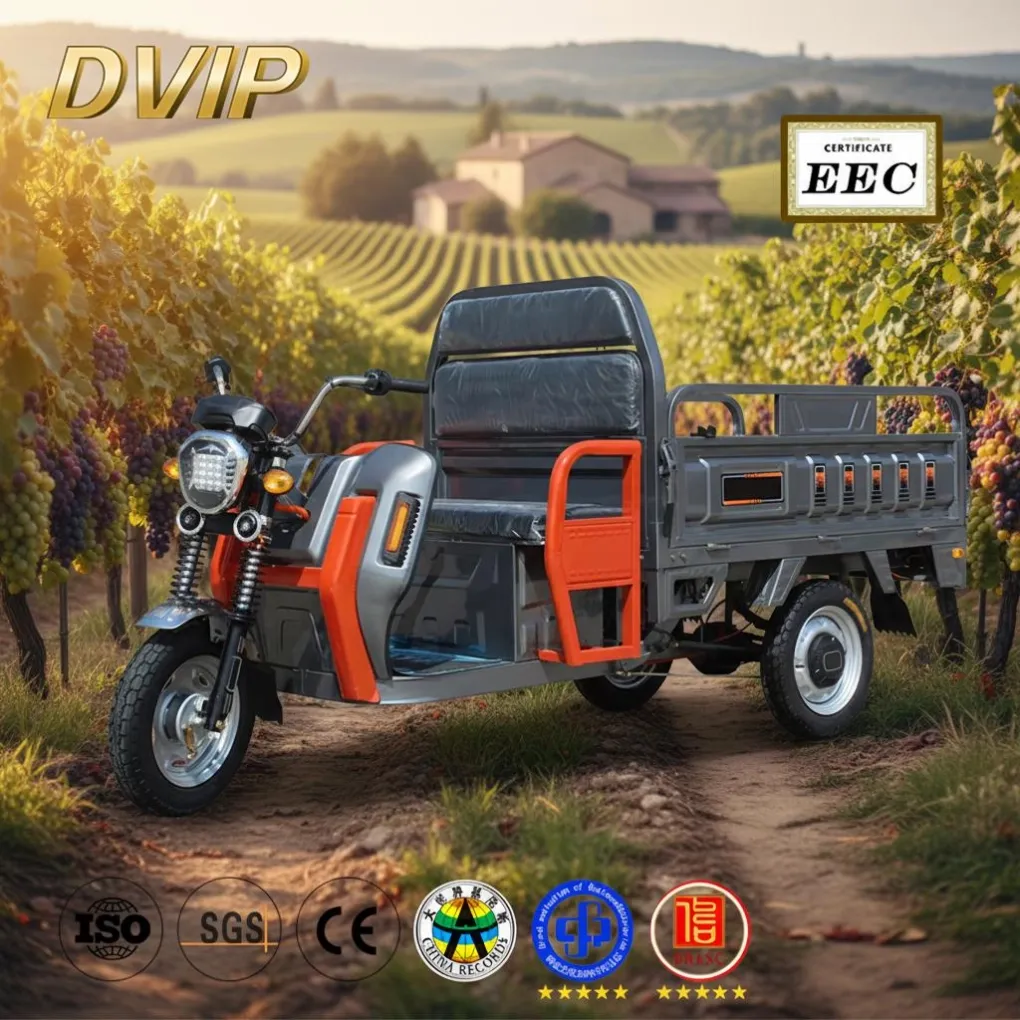
- Agricultural Businesses & Farms: Ideal for navigating narrow rows in olive groves, hazelnut orchards, vineyards, and greenhouses where heavy tractors are impractical.
- Last-Mile Logistics & Couriers: A game-changer for urban parcel, food, and high-frequency local distribution (such as water or gas bottle delivery).
- Industrial Zones & OSBs: Zero-emission and silent transport for maintenance crews, tools, and spare parts within massive factory compounds and logistics terminals.
- Municipalities & Public Facilities: Quiet, low-operating-cost utility vehicles for park maintenance, sanitation, and campus security.
- Coastal Resorts & Hospitality: Silent luggage and housekeeping transport that protects the peaceful environment of premium holiday villages.
2. Understanding SKD vs. CKD: Which Assembly Model Fits Your Business?
To minimize initial investment and reduce shipping volume, importing built-up vehicles (CBU - Completely Built-Up) is rarely the most cost-effective route. Instead, smart distributors leverage local assembly. The choice between SKD and CKD depends entirely on your local facility's capabilities and volume targets.
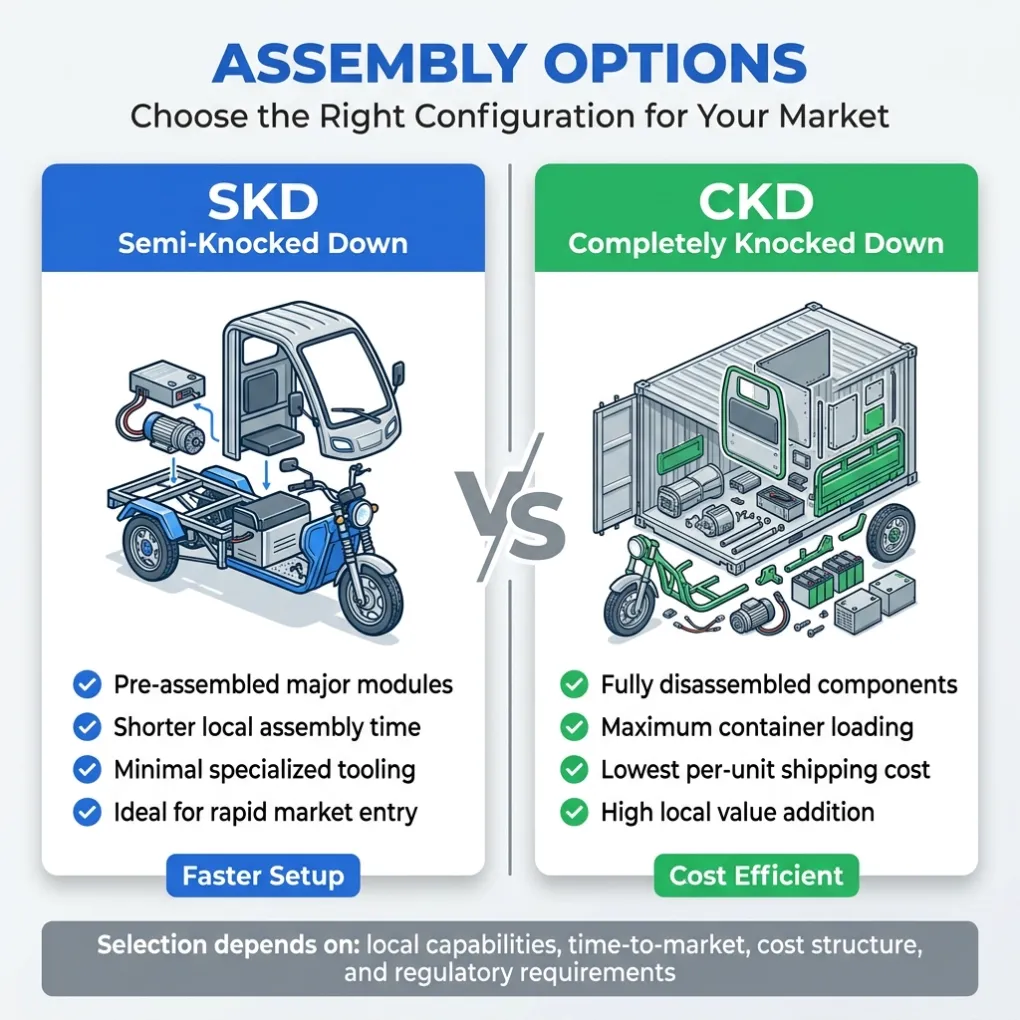
Option A: SKD (Semi-Knocked Down) — The Fast-Track Model
In an SKD setup, the vehicle is shipped in large, pre-assembled modules.
- What you receive: The main chassis is pre-welded and painted, the rear axle/gearbox is integrated, and the front-fork assembly is complete.
- Best for: Distributors looking for rapid market entry with minimum assembly time and basic tooling. It minimizes technical barriers while still qualifying for optimized customs structures in many importing countries.
Option B: CKD (Completely Knocked Down) — The Cost-Efficiency Model
In a CKD setup, the vehicle is fully disassembled down to its individual certified parts.
- What you receive: Fully unmounted components—including loose body panels, loose wiring harnesses, unassembled motors, and the compliant bare frame.
- Best for: Partners with established production lines, welding/painting capacity, or higher annual volumes. CKD maximizes container loading capacity (often doubling the units per container compared to SKD), significantly slashing ocean freight costs per unit and maximizing local value addition.
3. Step-by-Step: How to Import EEC Electric Tricycles
Importing industrial or road-legal vehicles isn't just about placing an order. To ensure a smooth, legal import process, every distributor should follow these five essential steps:
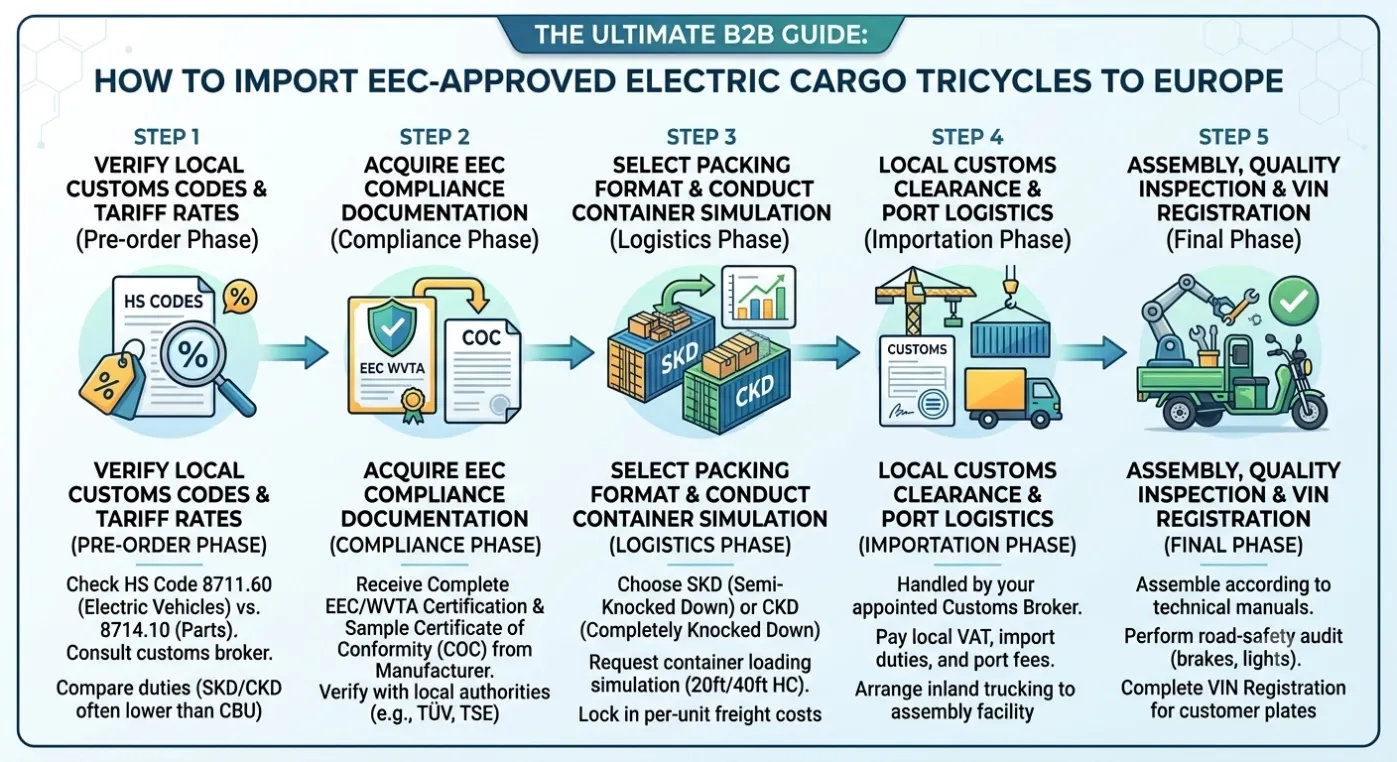
- Verify Local Customs Codes & Tariff Rates (Pre-order Phase)
Before transferring any funds, consult with your local customs broker. Check the specific import duties for electric vehicles under HS Code 8711.60 versus disassembled vehicle parts/components under HS Code 8714.10. In many jurisdictions, importing parts (SKD/CKD) attracts significantly lower tariff rates than importing fully built-up (CBU) vehicles.
2. Acquire EEC Compliance Documentation (Compliance Phase)
Following order confirmation and deposit payment, we provide the complete Whole Vehicle Type Approval (WVTA / EEC) certificate and the corresponding Certificate of Conformity (COC). These official documents are required by your local transport authority (such as the TÜV in Germany or TSE in Türkiye) to verify the vehicle platform's validity and clear it for road registration.
3. Select Packing Format & Conduct Container Simulation (Logistics Phase)
Determine whether SKD or CKD best fits your facility. Request a customized container loading simulation from our engineering team to calculate exactly how many units can pack into a 40ft High Cube (HC) container (our standard shipping unit to optimize ocean freight efficiency). This locks in your per-unit logistics cost and establishes compliance with our 1 x 40' HC Minimum Order Quantity (MOQ).
4. Local Customs Clearance & Port Logistics (Importation Phase)
Once the shipment arrives at your destination port, your appointed customs broker will handle the clearance, pay the local VAT/import duties, and arrange inland trucking to your assembly facility.
5. Assembly, Quality Inspection & VIN Registration (Final Phase)
Assemble the vehicles strictly according to the manufacturer's technical manuals. Conduct a standard road-safety audit (brakes, lights, alignment). Take the pre-stamped VIN (permanently marked on your factory-supplied frame) and the original COC document released with your shipment to your local vehicle registry to obtain the license plate and road registration for your customer.
4. Division of Responsibilities: Who Does What?
To ensure maximum operational efficiency and eliminate commercial friction, we believe in a transparent division of responsibilities between the Manufacturer and the Local Distributor. In the international automotive sector, a seamless partnership relies on a strict demarcation of upstream engineering versus downstream execution.
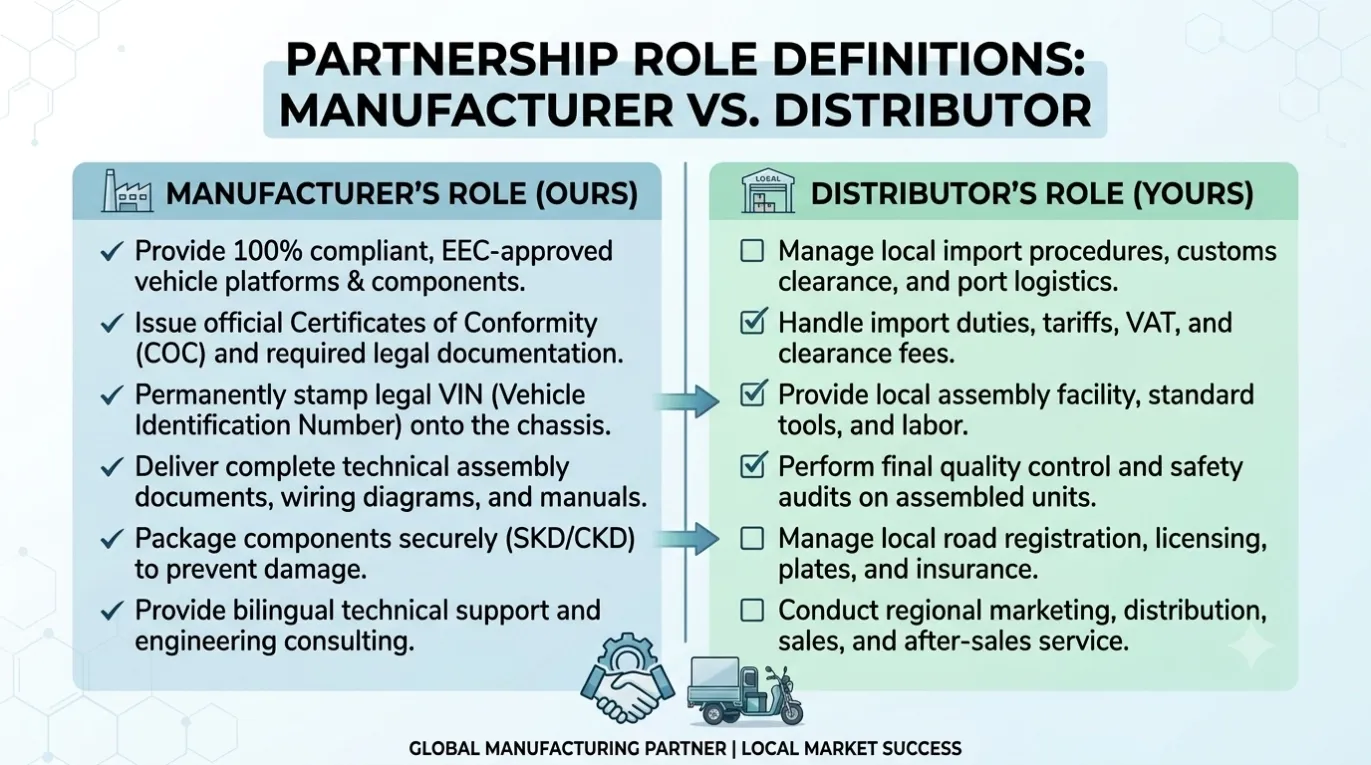
Strategic Alignment on Three Key Operational Hand-offs
To help your team prepare for import operations, here is the professional and regulatory reasoning behind how we split these critical responsibilities:
A. The Legal Boundary of VIN Stamping (Why We Handle It)
Under the European Whole Vehicle Type Approval (WVTA) framework, the Manufacturer of Record is the only legal entity authorized to stamp the official 17-digit VIN (Vehicle Identification Number) onto the chassis.
- The Rule: Local distributors or assembly facilities cannot alter, stamp, or fabricate the chassis frames locally, as doing so immediately invalidates the matching Certificate of Conformity (COC).
- Our Process: We permanently laser-stamp the legal VIN at our certified factory before packing. Your local team only needs to present this pre-stamped VIN and our COC to your regional registry (TÜV, TSE, etc.) to clear road-legal status.
B. Technical Support vs. Local Labor Execution
While we supply the vehicles in SKD or CKD formats, we recognize that local assembly speed directly dictates your profit margins.
- Our Support: We don't just ship parts; we provide clear, step-by-step structural assembly manuals, electrical routing schematics, and video walkthroughs.
- Your Execution: Your facility only requires standard commercial garage tooling (pneumatic drivers, basic lift gates, torque wrenches, and simple multimeters). No heavy industrial welding or painting investments are necessary, keeping your initial capital expenditure (CAPEX) remarkably low.
C. The After-Sales & Warranty Loop
A successful brand is built on rapid localized maintenance. Our split responsibility model ensures your customers are never left waiting for parts.
- Upstream Warranty: Hanride backs your operations with a robust manufacturer warranty covering the core electric powertrain components (such as the brushless motor, smart controller, and structural chassis frame) against manufacturing defects.
- Downstream Service: Your technical team acts as the first-line regional service provider, executing maintenance using our supplied diagnostic guides and localized spare parts inventory, ensuring your end-customers receive immediate, same-day support.
5. The Regulatory Red Line: Maintaining EEC/WVTA Compliance
When importing electric utility vehicles into Europe, regulatory compliance is non-negotiable. Under the strict European Whole Vehicle Type Approval (WVTA / EEC) framework, road-legality is tied to an absolute, locked technical configuration. This is where many importers make critical, costly mistakes.
⚠️ Critical Compliance Rules for Importers:
- No Unauthorized Substitutions: Every single part—from the main structural chassis down to the E-mark certified lights, mirrors, switches, and tires—must match the exact technical drawings and components approved during lab certification.
- The Chassis Standard: The chassis/frame is the legal carrier of the Manufacturer's VIN (Vehicle Identification Number). It must be manufactured by the certified factory of record.
- The Risk of Local Fabrication: Some local distributors attempt to weld or fabricate the vehicle frames locally to save on import costs. This is an absolute legal red line. Any local modification, part substitution, or unauthorized fabrication instantly invalidates the Certificate of Conformity (COC), making the vehicle completely illegal to register or license for road use.
Whether you choose SKD or CKD, all components must be uniformly manufactured, quality-controlled, and supplied by the certified manufacturer to guarantee 100% legal road registration.
6. A Phased, Low-Risk Pathway to Expansion
For industrial manufacturers or established equipment dealers looking to diversify, we recommend a proven, three-phase cooperation roadmap to scale up safely:
Phase 1: Market Entry & Local Setup
- Action: Import road-proven, EEC-certified vehicle platforms in SKD form.
- Goal: Establish an efficient, low-risk local assembly line, test early user feedback, and navigate the initial import and local registration processes with minimal technical friction.
Phase 2: Operational Optimization
- Action: Scale up annual purchasing volume and transition assembly workflows.
- Goal: Improve local assembly speed, optimize workplace tooling, establish a reliable local spare parts inventory, and expand dealer coverage in commercial and agricultural hubs.
Phase 3: Strategic Local Integration (Transition to CKD)
- Action: If annual market volume justifies the tooling investment, transition from SKD to CKD operations.
- Goal: Fully disassemble shipping batches to minimize sea freight costs per unit, maximize local labor utilization, and drastically improve local profit margins while maintaining 100% EEC compliance.
Partnering for Long-Term Growth
we believe the most successful international partnerships are built on complementary strengths. Our role is to deliver compliant, road-proven vehicle technology, rigorous quality-controlled component manufacturing, and full EEC homologation support. Your role is to leverage local assembly, regional logistics, and high-trust distribution networks.
By combining certified engineering with local assembly excellence, we can seamlessly deliver reliable, heavy-duty utility transport solutions that keep businesses moving.
Are you ready to explore SKD or CKD opportunities for your region?
Contact the Hanride Technical Export Team today to request our latest EEC-approved product catalog, technical specifications, and a customized container loading simulation.