
Oct 12, 2026Buyer Decision Center
7-STEP SOURCING FRAMEWORK-How to Choose the Right Electric Cargo Tricycle for Your Business
Learn how to select electric cargo tricycles for your market or fleet. Explore a real sourcing case, vehicle configuration, certification, operating costs and supplier evaluation.
7-STEP SOURCING FRAMEWORK-How to Choose the Right Electric Cargo Tricycle for Your Business
Choosing an electric cargo tricycle is not simply a matter of comparing prices, motor power or advertised range. For importers, regional distributors and commercial fleet operators, the right vehicle must match the intended application, meet relevant market requirements and make commercial sense over its working life.
One question is often overlooked during procurement: Does the vehicle the buyer wants actually fit the job it needs to do?
Based on our export inquiries, answering this question early can save time, prevent configuration mismatches and help buyers make better purchasing decisions.
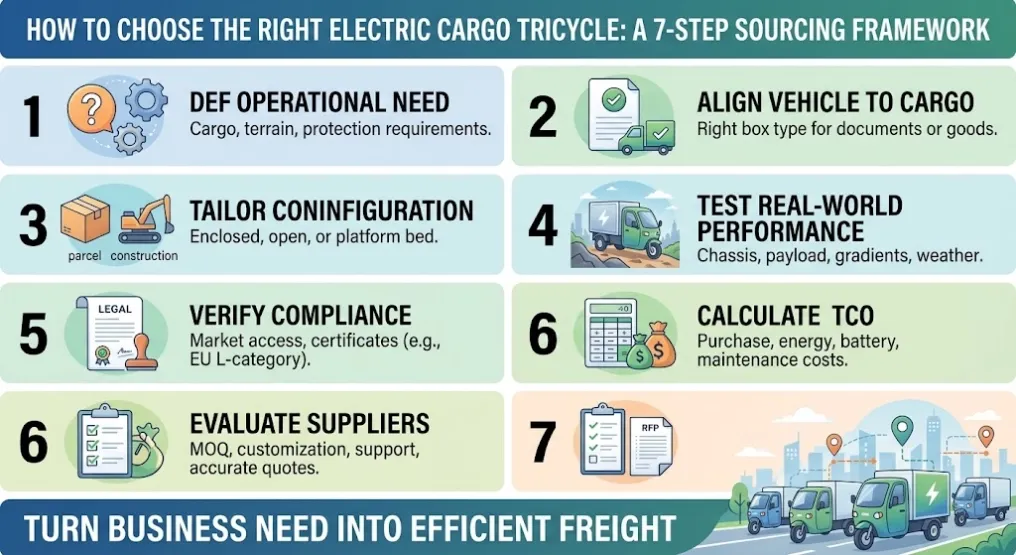
1. Start with the Application, Not the Product Catalogue
A buyer may arrive with a specific model in mind, a preferred certification or a list of technical specifications. These are useful starting points, but they do not fully define the right vehicle.
Before comparing quotations, clarify five things:
- What will the vehicle carry? Documents, parcels, groceries, agricultural products, tools or heavy materials?
- How must the cargo be protected? Does it need protection from rain, dust, theft or direct sunlight?
- Where will the vehicle operate? City streets, rural roads, farms, industrial sites or a mixture of conditions?
- How will it be used? Short trips with frequent stops, long daily routes, repeated loading or continuous operation?
- What does the business require? Road registration, a particular vehicle classification, low initial cost, high daily availability or a specific product range for distribution?
These questions influence the cargo body, cab design, chassis, powertrain, battery and compliance requirements.
For distributors, the goal is to select vehicles that fit the needs of their target customers. For fleet operators, the priority is to match the vehicle to actual routes, loads and daily operating requirements.
2. A Real Sourcing Lesson: The Requested Model Was Not Necessarily the Right Fit
In one export inquiry, a buyer from Russia contacted us about a 1.6-Mete electric cargo tricycle listed on our website. The model had a semi-enclosed cab, an open cargo body with three opening sides, and EU type approval.
The buyer was particularly interested in the certification because he associated it with better product quality. We discussed the vehicle, technical specifications, certification documents and VIN-related registration questions through several rounds of emails.
During the discussion, I asked about the vehicle's intended application.
The buyer explained that he planned to transport documents.
That changed the direction of the conversation.
For transporting documents, cargo protection may be more important than the open-sided loading flexibility of the original model. Depending on the cargo, route and security requirements, a vehicle with an enclosed cab and a fully enclosed cargo box could be a more suitable configuration.
The original model was not automatically the best choice simply because it was already available and had EU type approval.
We discussed the possibility of configuring a vehicle for more demanding road conditions. However, the alternative configuration would not carry the certification the buyer had originally requested. The project also involved only two vehicles, which was insufficient for our factory to accommodate the required customization. In the end, the order did not proceed.
This inquiry highlighted three practical lessons.
First, certification and application suitability are separate questions. A certification can be important for market access, but it does not by itself establish that a vehicle is ideal for a particular cargo or operating environment.
Second, the cargo body matters as much as the headline specifications. An open cargo body can be convenient for loading bulky goods, while an enclosed box may be more appropriate when weather protection and cargo security are priorities.
Third, technical feasibility does not guarantee commercial feasibility. A customized configuration may be possible in principle, but minimum order quantities, production constraints, cost and certification scope can determine whether the project is viable.
The lesson is not that buyers should avoid certified models or that customization is always preferable. It is that the intended application, market requirements and order quantity should be established before committing to a specific configuration.
3. Match the Vehicle Configuration to the Job
Once the application is clear, compare the main vehicle characteristics.
Application | Configuration to Consider | What to Verify |
Documents and parcel delivery | Enclosed cargo box | Weather protection, security, usable cargo space and access |
Retail and wholesale distribution | Open-sided or modular cargo body | Loading speed, cargo dimensions and flexibility |
Agriculture and construction support | Platform or reinforced cargo bed | Payload, ground clearance, tyres and suspension |
Warehouse and industrial transport | Compact utility body or platform | Manoeuvrability, braking and operating space |
These are starting points, not universal rules. The final choice depends on cargo dimensions, operating conditions and local regulations.
Payload and cargo volume
Do not assess a vehicle by its advertised payload alone. Confirm the permitted payload and gross vehicle weight, and check axle loads, tyres, brakes and suspension.
Also consider how the load will be distributed. High or unevenly positioned cargo can affect stability, particularly during turns or on sloping roads.
Payload and cargo volume are different requirements. A vehicle may carry the required weight but still lack sufficient space for bulky goods.
Motor and drivetrain
Frequent stops, heavy loads and continuous uphill operation place different demands on the motor, controller and rear axle.
Ask the supplier to clarify rated and peak motor power, and request performance information under conditions similar to your intended operation. Peak power alone does not establish whether a vehicle can sustain heavy work.
Battery and charging
Lead-acid batteries may offer a lower initial purchase cost. Lithium options, including LiFePO4, may be attractive for intensive operations where battery weight, usable energy and cycle life are important.
Compare the complete system rather than battery chemistry alone: capacity, warranty, charging time, temperature limits, replacement cost and charging infrastructure all matter.
4. Verify Real-World Performance Before Ordering
Advertised range and maximum gradeability are useful for initial screening, but buyers should understand the conditions behind these figures.
Driving range
Actual range varies with payload, speed, stop-start frequency, road gradients, temperature, tyre pressure, battery condition and driving style.
There is no single percentage that accurately predicts range loss for every electric cargo tricycle. Instead, ask the manufacturer:
- Under what load and test conditions was the advertised range measured?
- What battery capacity is installed, and how much energy is usable?
- Can the vehicle complete the planned daily route with an operating reserve?
- How does performance change under continuous load or frequent acceleration?
For a fleet operator, the relevant question is not whether the vehicle can achieve its best-case range. It is whether it can complete the required working day reliably.
Road conditions and durability
For rough roads, verify ground clearance, suspension design, chassis construction and tyre load ratings.
For sustained gradients, confirm the expected load, gradient, climbing duration and ability to restart on a slope. Controller limits, gearing and thermal protection can affect performance even when the motor's peak power appears sufficient.
In wet or dusty environments, ask for the protection ratings of relevant electrical components and connectors. A component-level IP rating should not be interpreted as proof that the entire vehicle is suitable for immersion or every severe weather condition.
Where performance is critical, request relevant test evidence or arrange a representative demonstration before placing a bulk order.
5. Treat Certification as a Market-Access Question
Certification should be assessed against the destination market and the exact vehicle configuration.
A buyer should clarify:
- Is the vehicle intended for public-road use or private-site operation?
- Which vehicle category and technical requirements apply locally?
- Is a specific type approval or other conformity documentation required?
- Does the documentation cover the exact model and configuration being purchased?
- Are VIN, registration and other required documents available for that vehicle?
Do not assume that EU type approval is required in every market. Equally, do not assume that it is irrelevant simply because the destination is outside the EU. Confirm the applicable requirements with the relevant local authorities or qualified compliance specialists.
Certification and quality control are also not interchangeable. Certification may establish conformity with specified regulatory requirements, but buyers should separately evaluate manufacturing consistency, component quality, inspection procedures and after-sales support.
6. Compare Total Cost of Ownership, Not Just FOB Price
For bulk buyers, the lowest quoted price is not necessarily the most economical option.A practical total cost of ownership (TCO) model includes:
TCO = Vehicle purchase cost + Energy + Battery replacement + Maintenance and spare parts + Compliance and insurance + Downtime
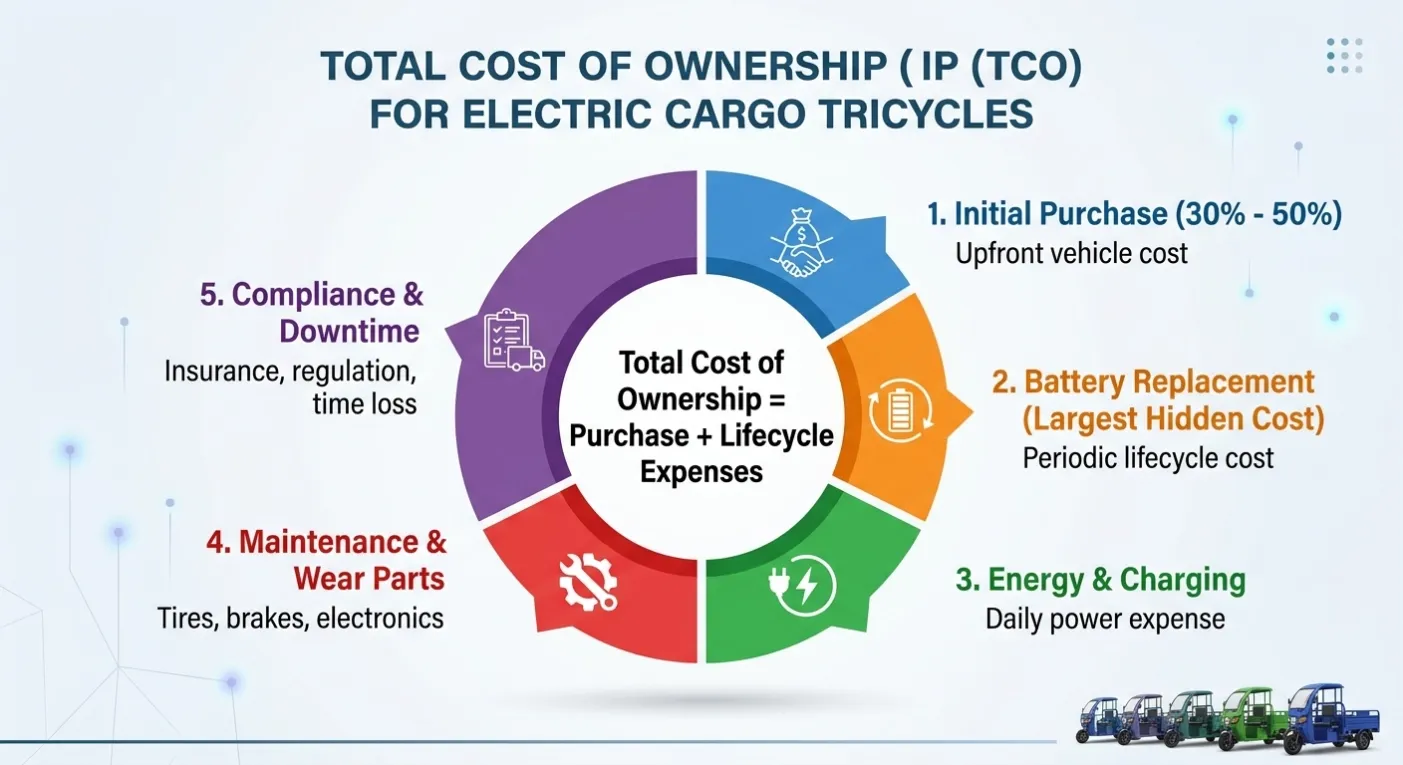
For imported vehicles, calculate landed cost separately where relevant, including freight, insurance, customs duties, taxes and local handling.
When comparing suppliers, ask about:
- Battery warranty and replacement cost.
- Common wear parts and spare-parts availability.
- Maintenance requirements and technical documentation.
- Warranty coverage and fault-handling procedures.
- Expected delivery time for replacement components.
- Minimum order quantity and customization charges.
A lower-cost vehicle may still be the right choice for light or occasional use. A higher-priced model may make more sense for intensive operations if its verified performance, serviceability and lifecycle costs justify the difference.
The decision should be based on your operating requirements and comparable supplier data, not on a general claim that one technology or price level is always better.
7. Evaluate Suppliers Before Committing to an Order
Once the required configuration is defined, assess whether the supplier can deliver it consistently and commercially.
Evaluation Area | Questions to Ask |
Product suitability | Does the proposed configuration match the cargo, route and operating conditions? |
Technical evidence | Can the supplier support key claims about payload, range and climbing performance? |
Quality control | How are incoming components, production processes and finished vehicles inspected? |
Compliance | Do the available documents apply to the exact model and destination market? |
After-sales support | Are spare parts, maintenance instructions and warranty procedures available? |
Commercial feasibility | Are the MOQ, customization cost, lead time and order quantity compatible? |
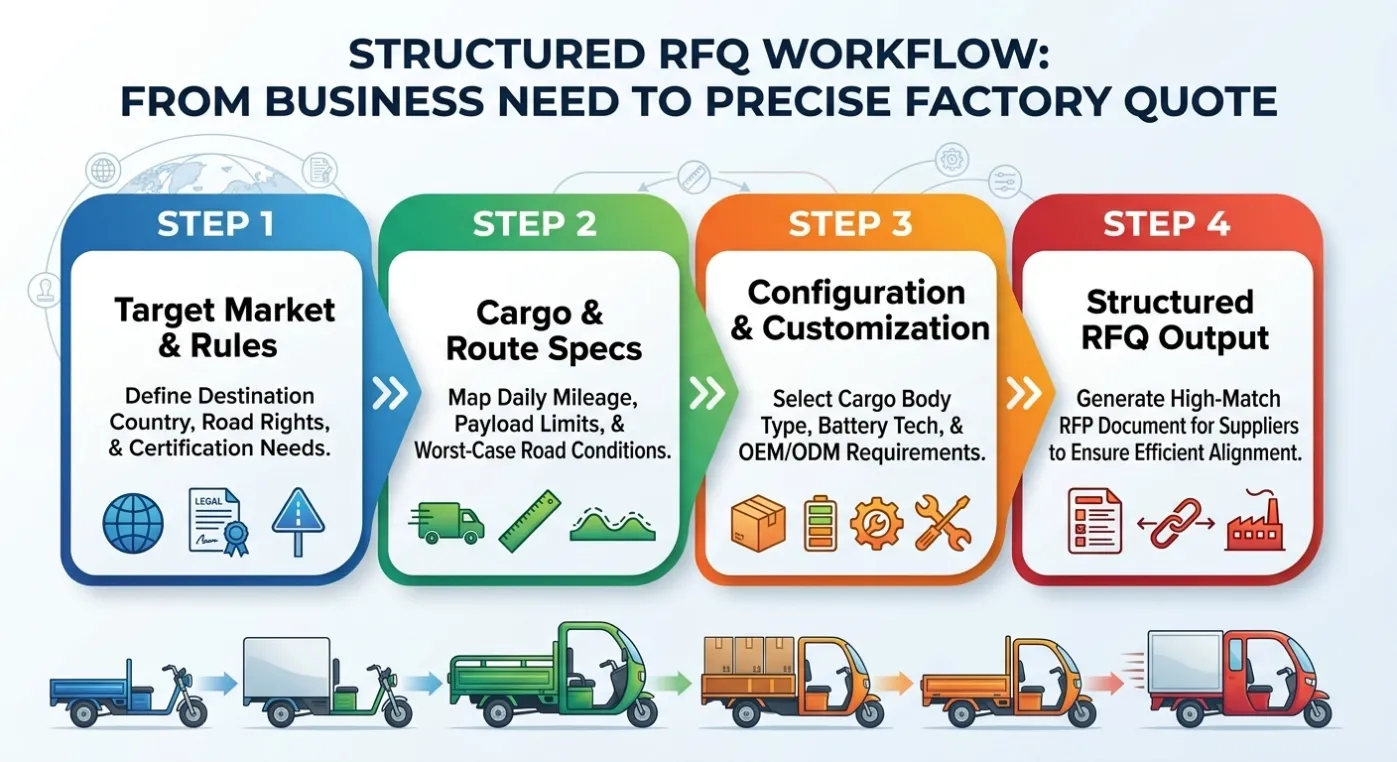
Before requesting quotations, prepare a clear RFQ (Request for Quotation) containing:
- Destination country and intended vehicle use.
- Cargo type, typical and maximum payload, and cargo dimensions.
- Daily mileage, road conditions and expected gradients.
- Required cab, cargo body, battery and powertrain configuration.
- Applicable certification and registration requirements.
- Initial order quantity, estimated annual demand and customization needs.
- Quotation basis, delivery schedule, warranty and spare-parts requirements.
Providing the same information to each supplier makes quotations easier to compare and reduces repeated clarification.
Conclusion: Choose the Vehicle That Fits Your Business
The right electric cargo tricycle is not necessarily the model with the highest specifications, the lowest price or the most certifications. It is the vehicle that fits the intended application, satisfies the relevant market requirements and makes sense for the buyer's operating and commercial conditions.
For importers and distributors, that means considering market demand, product positioning, compliance, minimum order quantities and long-term supplier support. For fleet operators, it means focusing on cargo suitability, real-world performance, vehicle availability and total operating cost.
Before committing to an order, make sure the supplier understands what the vehicle needs to do—not just which model you initially requested.
A better purchasing decision starts with the right questions, before it starts with a quotation.
For more product purchasing guidance, please read the following related articles.
Electric Cargo Tricycle Manufacturers in China: 2026 Sourcing Guide
How to Verify an Electric Cargo Tricycle Supplier Before Your First Order
How to Choose High-Quality Electric Tricycles for Internal Logistics Operations
How to Maximize Battery Lifespan in Port & Industrial Electric Tricycles: A Procurement Guide
Reducing TCO in Port Internal Logistics: How Define "High-Quality" Through Operational Certainty
Lead-Acid vs Lithium Battery: Which Is Right for Exporting Electric Tricycles?
How to Choose a Truly "Controllable" Electric Tricycle for last mile delivery
How to Make Your Electric Tricycle Run Longer: 12 Practical Maintenance Tips for Maximum Battery Life
How to Choose the Right Electric Tricycle: Port, City, and Home Applications Explained