Oct 12, 2026Buyer Decision Center
Electric Cargo Tricycle Manufacturers in China: 2026 Sourcing Guide
Explore China's electric cargo tricycle industry, regional manufacturing hubs, indicative FOB prices, factory capabilities, and sourcing strategies for overseas buyers.
Electric Cargo Tricycle Manufacturers in China: 2026 Sourcing Guide
1. China's Electric Cargo Tricycle Industry: Market Trends in 2025–2026
China is a major manufacturing base for electric two-wheelers and three-wheelers, supplying vehicles for agricultural transport, local delivery, warehouse operations, light industry, and commercial mobility.
For overseas importers, however, finding a suitable electric cargo tricycle manufacturer involves more than comparing quotations. Vehicle specifications, manufacturing capabilities, component quality, export experience, and destination-market regulations all affect the long-term value of a purchase.
Market data and industry outlook
According to data attributed to the China Chamber of Commerce for Import and Export of Machinery and Electronic Products (CCCME), China exported approximately 26.75 million electric two-wheelers in 2025, with an export value of around US$6.83 billion. Export volume increased by 20.9% year on year, while export value rose by 17.4%.
These figures illustrate the broader export momentum of China's electric two-wheeler industry. They should not be interpreted as electric cargo tricycle export statistics, because the product categories and statistical coverage differ.
The following figures provide a preliminary overview of the electric cargo tricycle market. They are industry estimates for initial sourcing and market planning, rather than a unified set of official statistics.
Market indicator | Preliminary estimate | Implications for buyers |
Annual cargo e-tricycle production | Approximately 3.2 million units | Indicates a substantial manufacturing base, subject to the underlying product definition |
Annual export volume | Approximately 1.8 million units, or 56% of estimated production | Suggests a significant export-oriented segment; the production and export figures require consistent statistical coverage |
Primary export markets | Southeast Asia, Africa, Latin America, the Middle East, and selected European applications | Different markets require different configurations, price points, and compliance strategies |
Indicative FOB price range | US$850–US$2,200 per unit | Actual prices depend on vehicle specifications, battery type, order quantity, and export requirements |
Estimated market growth, 2026–2030 | Approximately 12.3% CAGR | Provides a preliminary growth assumption for market planning, not a guaranteed industry forecast |
Data note: These figures represent preliminary industry research and estimates. Market size, export volume, average prices, and growth forecasts may vary depending on product definitions, statistical sources, and market coverage. Buyers and investors should verify the underlying sources before using these figures for financial projections.
What do these trends mean for overseas buyers?
Demand for electric cargo tricycles is closely linked to practical business requirements. Farms need vehicles that can handle agricultural loads and uneven ground. Distributors need affordable products with dependable spare-parts support. Delivery operators need vehicles that can complete daily routes with minimal downtime.
Battery selection also depends on daily mileage, charging access, ambient temperature, purchase budget, and local maintenance capabilities.
The key takeaway is straightforward: the most competitive vehicle is not necessarily the one with the lowest FOB price, but the one that delivers the right balance of purchase cost, operating performance, durability, and serviceability for its intended application.
2. Where Are China's Main Electric Tricycle Manufacturing Regions?
China's electric tricycle supply chain is geographically distributed. Different manufacturing regions have developed different strengths, although actual capabilities vary significantly between individual factories.
The following comparison is intended to help buyers narrow their supplier search, not to establish a definitive ranking of all manufacturers.
Manufacturing region | Key industrial areas | Typical strengths to investigate | Potentially suitable buyers | Considerations |
Zhejiang | Huzhou, Hangzhou, and other relevant manufacturing areas | OEM production, lithium-battery integration, and logistics-oriented models | Buyers seeking specific vehicle platforms or technology configurations | MOQ and customization flexibility vary by supplier |
Guangdong | Shenzhen, Dongguan, Foshan | Export-oriented ODM, electronics integration, and customization | Brand owners seeking product differentiation and specific electronic features | Product complexity and customization may increase cost |
Jiangsu — established industrial areas | Changzhou, Suzhou, Wuxi | Established manufacturing networks, vehicle components, and diverse production capabilities | Dealers and importers comparing established suppliers | Product range and production flexibility depend on the manufacturer |
Jiangsu — Xuzhou Fengxian | Fengxian and surrounding industrial areas | Electric tricycle manufacturing, component supply, and a range of cargo-vehicle configurations | Buyers sourcing cargo tricycles for commercial, agricultural, and industrial applications | Individual factory capabilities and export experience require verification |
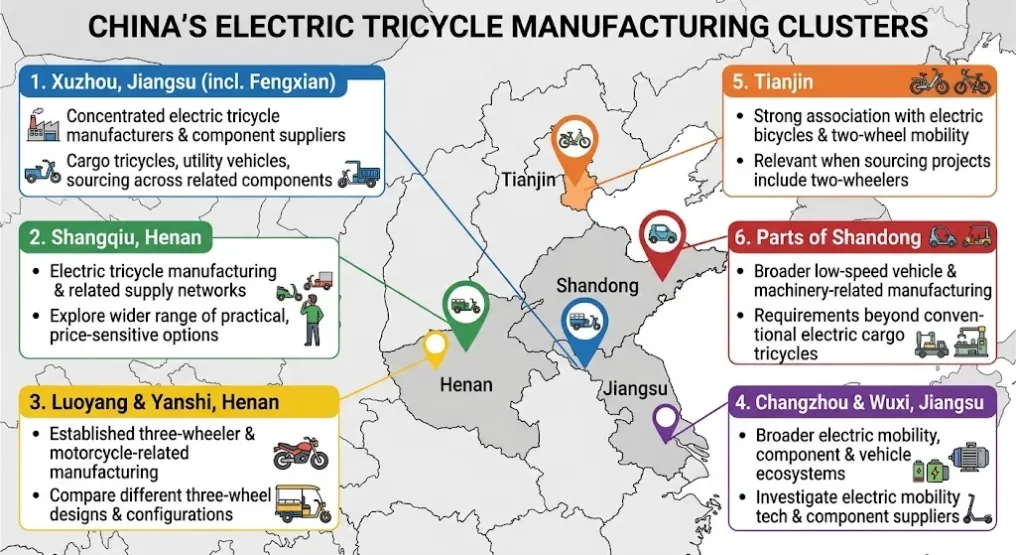
These are broad regional observations, not
guarantees about every supplier. A factory in a well-known industrial cluster may still lack experience with a particular vehicle category, destination market, or customer application.
How should importers use this comparison?
Start with the intended application and required vehicle configuration. Then identify the manufacturing regions and suppliers most likely to offer suitable products.
For buyers focused on electric cargo tricycles, Xuzhou Fengxian deserves particular attention because of its concentrated tricycle manufacturing and supporting component industry.
3. Why Is Xuzhou Fengxian Important to Electric Cargo Tricycle Buyers?
Fengxian is a county-level area under Xuzhou, Jiangsu Province. It has developed a substantial electric vehicle manufacturing cluster, particularly around electric tricycles and supporting components.
Recent local and provincial industry reports have described the area as having more than 1,400 vehicle and component businesses, with annual complete-vehicle production capacity exceeding 5 million units.
These figures describe the wider local electric vehicle industry rather than cargo tricycles alone. Production capacity also differs from actual annual output, sales, and export volume.
The strategic advantage: A concentrated manufacturing ecosystem
Fengxian's significance is not simply the number of factories located there. The concentration of related manufacturers and component suppliers creates several potential advantages for overseas buyers.
1. More opportunities to compare manufacturers
A concentrated industrial area can make it easier to investigate multiple suppliers during one sourcing trip. Buyers can compare frame structures, cargo-body designs, motor and controller configurations, production processes, and commercial terms.
This is especially useful when a buyer has not yet finalized the vehicle specification and needs to evaluate several possible configurations.
2. Access to supporting component suppliers
Electric cargo tricycles rely on interconnected systems, including frames, motors, controllers, batteries, brakes, tyres, lighting, and electrical wiring.
A developed component network can help manufacturers coordinate sourcing and production. It may also provide advantages when planning replacement parts and long-term maintenance, although the availability of specific components must be confirmed with each supplier.
3. Opportunities for application-specific vehicle selection
A distributor serving agricultural customers may prioritize ground clearance, cargo capacity, and ease of repair. A delivery operator may focus on daily range, loading access, manoeuvrability, and vehicle uptime.
Fengxian's manufacturing ecosystem gives buyers a practical location in which to investigate different cargo-transport configurations rather than relying exclusively on standardized catalogue models.
Three potential sourcing advantages worth evaluating
- Chassis robustness: Some Fengxian manufacturers offer heavy-duty frame configurations intended for demanding cargo applications. Buyers should compare frame dimensions, material specifications, welding quality, suspension, and rated payload instead of assuming that all local vehicles use thicker steel than products from other regions.
- Small-batch flexibility: Some suppliers may accept minimum order quantities as low as 50 units, depending on the model and configuration. This can help new distributors test demand before committing to larger volumes.
- Port access and logistics: Fengxian's location in Jiangsu makes inland transportation to coastal ports an important part of export planning. Lianyungang is one port that buyers may consider, but the best shipping route depends on the supplier's location, destination, sailing schedule, and total logistics cost. The potential 8–10% inland logistics cost advantage should be treated as a preliminary estimate to validate against actual quotations.
The important distinction is that an industrial cluster creates sourcing opportunities; it does not automatically guarantee a lower price, better quality, or faster delivery. Those advantages must be established at the supplier and vehicle level.
4. What Can Buyers Expect from Fengxian Manufacturers?
Factory size, production capacity, and export readiness are important indicators, but they need to be assessed in context. The following figures represent indicative capabilities reported for some established manufacturers, not universal standards for all Fengxian factories.
- Manufacturing scale and quality control
Indicator | Indicative capability | What buyers should verify |
Annual production capacity | Some leading factories report 100,000+ units | Actual production volume, product mix, and available capacity for the required model |
Workshop area | Some facilities exceed 20,000 m² | Whether the stated area belongs to the actual manufacturing operation |
Welding and assembly | Some factories use automated welding equipment and organized assembly lines | Which processes are automated and which are completed manually |
Quality inspection | A three-stage process may cover incoming materials, semi-finished products, and finished vehicles | Inspection records, test procedures, acceptance criteria, and corrective actions |
Defect rate | Some well-managed facilities report rates below 0.3% | The definition of a defect, calculation method, sample period, and whether the figure is independently verified |
A reported defect rate has limited value unless its calculation method is clear. For example, a factory's internal production defect rate may not include failures discovered after shipment or during actual vehicle operation.
Buyers should ask how quality is monitored throughout production and what evidence is available to support the manufacturer's claims.
B. Customization and export readiness
Manufacturers may offer different configurations for different operating environments.
- Africa: Depending on the target market, buyers may prioritize robust suspension, serviceable mechanical systems, suitable battery protection, and readily available replacement parts.
- Southeast Asia and the Middle East: Buyers may need to consider heat exposure, rain, dust, water ingress, daily operating range, and local charging conditions. Waterproofing claims should be supported by a specified IP rating or relevant test evidence where applicable.
- Private-label projects: Custom colors, logos, cargo-body designs, and selected functional features may be available, subject to tooling, order quantity, production capacity, and approval requirements.
Some suppliers may quote sample lead times of 7–10 days and mass-production lead times of 20–25 days. These should be treated as indicative supplier timelines rather than industry-wide standards. The actual schedule depends on component availability, configuration, order size, inspection requirements, and factory workload.
English-language technical support and export-documentation experience should also be confirmed directly. Do not assume that every manufacturer has a dedicated technical team or can independently manage all destination-market compliance requirements.
5. Compliance and Risk Mitigation for 2026 Imports
Compliance should be assessed against the specific vehicle, destination country, intended use, and applicable regulations. A supplier's general claim that its products are export-ready is not sufficient.
Risk area | What buyers should verify |
Battery shipping | Applicable battery transport documentation, UN 38.3 test documentation where required, packaging requirements, and carrier acceptance |
EU road approval | Applicable vehicle category, relevant type approval under Regulation (EU) No 168/2013 where applicable, and CoC requirements for the exact vehicle |
Customs classification | Destination-specific tariff classification, Chinese export classification, and any applicable export licensing requirements |
Vehicle documentation | Consistency between the physical vehicle, VIN, approved specifications, invoices, packing lists, and required conformity documents |
Configuration changes | Whether substitutions or modifications affect approval status, documentation, or registration eligibility |
Why the exact vehicle specification matters
For European buyers considering L-category vehicles, confirm that the relevant approval covers the exact model and configuration being purchased. A certificate for a similar-looking vehicle does not automatically establish that another configuration is approved.
Likewise, the presence of a VIN and a Certificate of Conformity does not, by itself, prove that every vehicle meets every requirement in every destination market. The applicable approval and registration conditions must be checked for the specific vehicle.
Customs classification also requires care. Do not assume that one HS code applies to every electric tricycle simply because it uses electric propulsion. Vehicle structure, intended use, and the applicable national tariff schedule can affect classification.
A practical pre-shipment inspection checklist
Before shipment, consider arranging an inspection covering:
- Vehicle model and configuration against the approved purchase specification.
- VIN stamping and identification labels.
- Motor, controller, battery, and other critical component specifications.
- Frame, welding, assembly, braking, lighting, and general workmanship.
- Battery labels and relevant shipping documentation.
- Required vehicle certificates and consistency of the accompanying documents.
- Packaging, accessories, and spare parts included in the order.
For regulated vehicles, documentation should be checked against the actual approved configuration. If a component or specification has changed, ask the supplier to confirm whether the change affects conformity or registration.
6. Strategic Sourcing Recommendations for Different Buyers
The right supplier depends on the target market, application, purchasing volume, and business model. The following scenarios provide a practical starting point.
Scenario A: Emerging-market distributors
Typical priorities: Purchase price, durability, local serviceability, and long-term operating cost.
Investigate Fengxian-based suppliers alongside other relevant manufacturing options. Compare frame construction, rated payload, suspension, battery configuration, replacement-part availability, and the supplier's willingness to support an initial trial order.
For some distributors, lead-acid configurations may offer a lower entry price. However, battery selection should account for daily use, charging access, replacement cost, and local maintenance conditions.
If a supplier accepts 50–100 units as an initial order, assess whether the quantity is commercially appropriate for your market and whether the manufacturer can support repeat orders using the same specification.
Scenario B: EU and other regulated-market buyers
Typical priorities: Product conformity, traceability, documentation, and after-sales support.
Compare suppliers based on their experience with the specific vehicle category and destination market. Request the relevant type-approval documentation, confirmation of the exact configuration, and a clear process for issuing the documents required for individual vehicles.
Do not select a vehicle based on appearance or price before confirming that the proposed model is appropriate for the intended registration and use.
Scenario C: Private-label brand owners
Typical priorities: Product differentiation, brand consistency, and a manageable route to market.
Investigate manufacturers that can support the required logo, colors, cargo-body design, and approved functional modifications. Fengxian may offer relevant options because of its concentrated tricycle manufacturing ecosystem.
However, confirm minimum order quantities, tooling charges, sample approval procedures, production lead times, and the effect of modifications on conformity documentation. A customization option is only commercially useful if it can be delivered consistently at the required volume and cost.
7. Electric Cargo Tricycle Prices: How Should Buyers Compare Quotations?
As an initial budgeting reference, the estimated FOB price range of US$850–US$2,200 per unit covers a broad range of electric cargo tricycle configurations. It should not be interpreted as a verified market average or a guaranteed current quotation.
Indicative price segments from preliminary market research include:
Configuration segment | Indicative FOB price | Main considerations |
Lead-acid configurations | US$850–US$1,100 | Initial purchase budget, battery replacement, payload, and maintenance |
Lithium-ion configurations | US$1,100–US$1,800 | Battery capacity, usable energy, charging requirements, and expected service life |
Higher-specification or smart-feature models | Above US$2,000 | Additional features, electronic systems, customization, and specific equipment requirements |
These ranges are preliminary estimates. Actual quotations may fall outside them depending on the model, order quantity, supplier, and specification.
Two vehicles that look similar in photographs may differ significantly in frame construction, battery capacity, motor and controller versions, braking equipment, and other components.
When requesting quotations, ask each supplier to specify:
- Exact model and configuration.
- Rated payload and motor power, including rated and peak figures where relevant.
- Battery chemistry, voltage, capacity, charger, and warranty.
- Incoterm, order quantity, and delivery lead time.
- Customization charges, packaging, and included accessories.
- Required export and conformity documents.
- Warranty conditions, spare-parts availability, and after-sales arrangements.
Compare equivalent specifications rather than headline prices. A lower FOB quotation is meaningful only when the products and commercial terms being compared are genuinely equivalent.
FOB price versus total cost of ownership
The purchase price is only one part of the economics of an electric cargo tricycle.
For a distributor or fleet operator, the total cost of ownership can also include:
- Freight, insurance, import duties, and local taxes.
- Battery replacement and routine maintenance.
- Spare parts and repair labor.
- Vehicle downtime and lost operating capacity.
- Warranty administration and after-sales support.
A vehicle with a higher purchase price may still be the better business choice if it better matches the operating environment and reduces avoidable maintenance or downtime. The outcome depends on actual performance and operating costs, not the price category alone.
8. How to Reduce Sourcing Risks When Buying from China
Whether you discover a supplier online or visit an industrial cluster, verify the manufacturer's capabilities before placing a substantial order.
1. Verify the supplier's identity.
Confirm the legal identity of the contracting company and establish whether it manufactures the vehicle itself or outsources major production stages. Request current factory information and arrange an inspection when commercially appropriate.
2. Verify the technical specification.
Confirm the rated payload, motor and controller models, battery configuration, braking equipment, dimensions, and stated operating range. Ask how performance figures were measured and whether they reflect conditions similar to your intended use.
3. Evaluate quality-control procedures.
Ask how incoming components, welding, assembly, electrical systems, and finished vehicles are inspected. Written inspection procedures and actual records are more useful than a general statement that a factory has strict quality control.
4. Confirm destination-market requirements.
Check the relevant vehicle category, conformity requirements, customs classification, and registration conditions before finalizing the specification. A vehicle suitable for domestic use may not automatically qualify for road use or registration overseas.
5. Clarify warranty and spare-parts support.
Establish the warranty period, covered components, exclusions, claim process, and responsibility for replacement parts and transport costs. Confirm whether commonly serviced parts can be supplied throughout the expected service life.
6. Agree on a written purchase specification.
Document the exact configuration, inspection criteria, delivery schedule, packaging, warranty, and required documents. This gives both parties a clearer basis for production and acceptance.
Conclusion: Is Xuzhou Fengxian the Right Place to Source Electric Cargo Tricycles?
For overseas importers, distributors, and fleet operators, Xuzhou Fengxian is a strategic manufacturing area worth including in a China sourcing plan. Its concentrated electric tricycle and component industry creates opportunities to compare suppliers, explore different cargo-transport configurations, and investigate component and spare-parts options.
Its potential value lies in the range of manufacturing and sourcing opportunities available—not in a guarantee that every factory offers the same quality, price, or flexibility.
The most effective sourcing strategy starts with the buyer's business requirements. Define the intended application, operating conditions, payload, battery needs, maintenance expectations, and destination-market requirements. Then compare equivalent specifications, verify manufacturer capabilities, and assess total cost of ownership alongside FOB price.
The objective is not simply to find an electric cargo tricycle factory in China. It is to find the vehicle and supplier combination that fits your market, serves your customers' actual needs, and supports sustainable business growth.
Frequently Asked Questions
Where can I find electric cargo tricycle manufacturers in China?
Xuzhou Fengxian in Jiangsu Province is an important area to investigate because of its concentrated electric tricycle and component industry. Other regions may also be relevant depending on the required vehicle design, production capabilities, and export requirements. Verify individual manufacturers rather than relying on regional reputation alone.
What is the FOB price of an electric cargo tricycle from China?
Preliminary estimates suggest a broad range of approximately US$850–US$2,200 per unit for different configurations. Actual prices depend on the battery, motor, chassis, cargo body, order quantity, and export requirements. Request current quotations against a defined specification.
How do I choose between lead-acid and lithium batteries?
Lead-acid batteries may suit buyers prioritizing a lower initial purchase price. Lithium batteries may be more appropriate where weight, charging patterns, and operating requirements justify the additional investment. Compare capacity, warranty, replacement cost, expected service life, and local maintenance conditions.
What certifications are needed to import electric cargo tricycles into Europe?
Requirements depend on the vehicle category and intended use. For applicable L-category vehicles, verify the relevant EU type approval and the CoC requirements for the exact model and configuration. Also check battery transport documentation and any other applicable destination-market requirements.
Are Fengxian manufacturers suitable for heavy-duty cargo applications?
Fengxian has a concentrated electric tricycle manufacturing industry, and some suppliers offer configurations intended for demanding cargo applications. Buyers should verify the rated payload, chassis construction, suspension, braking system, and performance under the intended operating conditions rather than assuming all models have the same capabilities.
For more product purchasing guidance, please read the following related articles.
How to Choose the Right Electric Cargo Tricycle for Your Business
How to Verify an Electric Cargo Tricycle Supplier Before Your First Order
How to Choose High-Quality Electric Tricycles for Internal Logistics Operations
How to Maximize Battery Lifespan in Port & Industrial Electric Tricycles: A Procurement Guide
Reducing TCO in Port Internal Logistics: How Define "High-Quality" Through Operational Certainty
Lead-Acid vs Lithium Battery: Which Is Right for Exporting Electric Tricycles?
How to Choose a Truly "Controllable" Electric Tricycle for last mile delivery
How to Make Your Electric Tricycle Run Longer: 12 Practical Maintenance Tips for Maximum Battery Life
How to Choose the Right Electric Tricycle: Port, City, and Home Applications Explained