
Oct 12, 2026Buyer Decision Center
How to Verify an Electric Cargo Tricycle Supplier Before Your First Order
Buying an electric cargo tricycle from China is not only a question of price and specifications.Before placing your first order, you need to know who is actually behind the vehicle, whether the produc
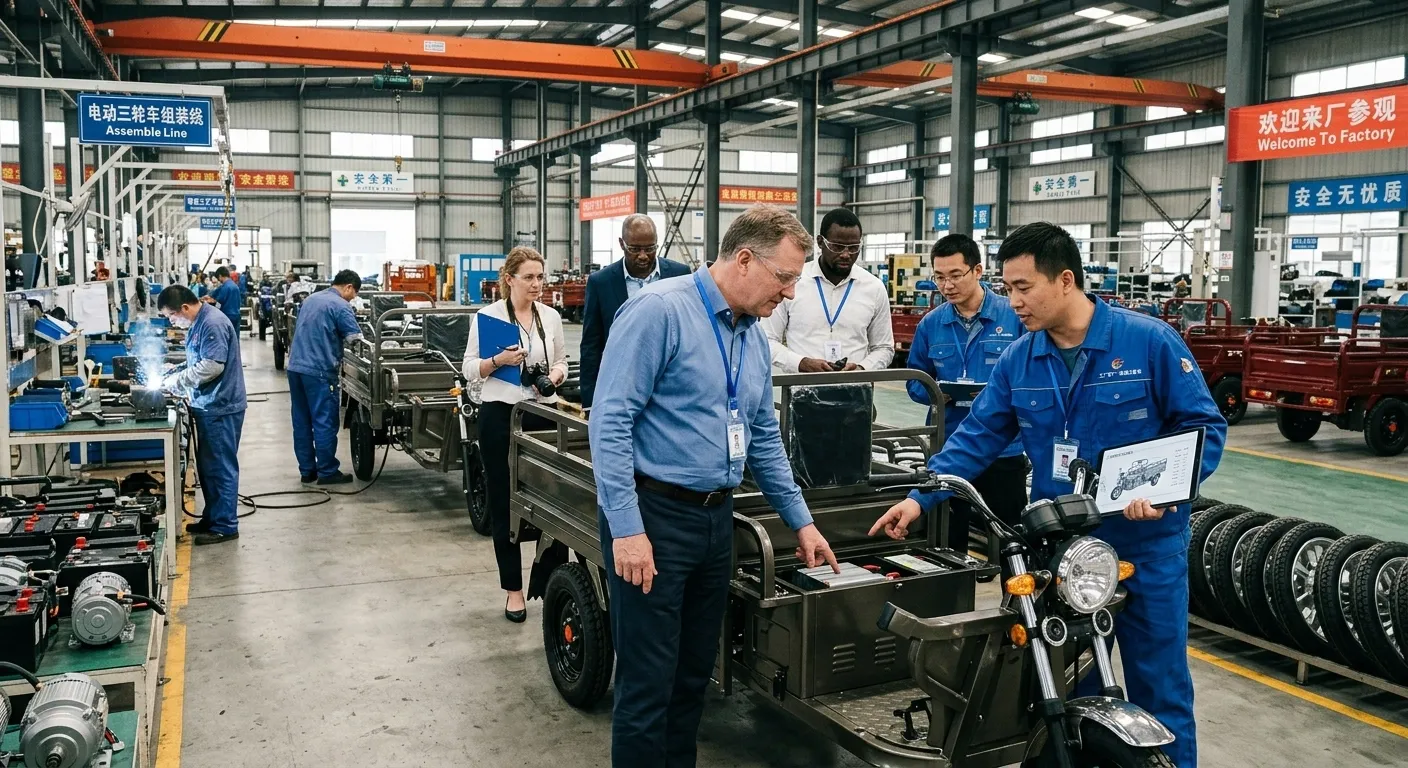
How to Verify an Electric Cargo Tricycle Supplier Before Your First Order
An independent buyer’s checklist for sourcing electric cargo tricycles from China
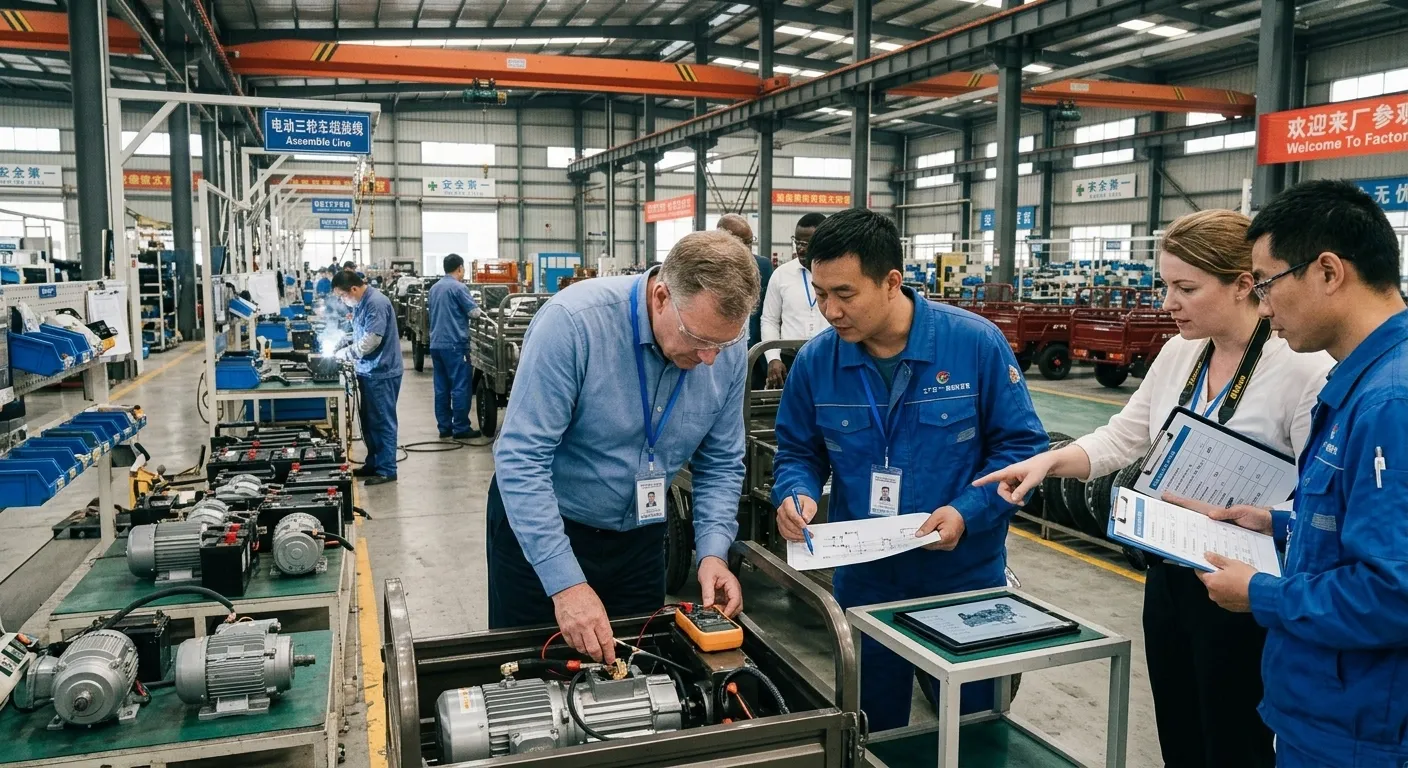
Buying an electric cargo tricycle from China is not only a question of price and specifications.Before placing your first order, you need to know who is actually behind the vehicle, whether the product information is clear and consistent, whether the production can be verified, and whether the commercial terms are properly defined.
This is especially important for commercial electric cargo tricycles because they are working vehicles. The buyer may depend on them for daily delivery, agricultural transport, industrial logistics or other commercial operations.A supplier that looks good on a website is not necessarily a supplier that has been properly verified.
The good news is that you do not need an extremely complicated due-diligence process.A few practical checks can eliminate many avoidable risks before you send the deposit.
Quick Answer: What Should You Check Before Your First Order?
Before paying a new electric cargo tricycle supplier, check these six areas:
- Manufacturer identity and WMI
- Exact vehicle and configuration
- Destination-market requirements
- Production and factory verification
- Pre-shipment inspection
- Final order and commercial terms
The basic principle is simple:
Verify the supplier, verify the vehicle, verify the production, then verify the order before you pay.
You do not need to collect every possible document.You need enough evidence to understand what you are buying and who is responsible for supplying it.
1. Verify Who Actually Manufactures the Vehicle
One of the first questions to ask is:Who is the actual vehicle manufacturer?
A Chinese supplier may be:
- a vehicle manufacturer;
- a factory-owned export department;
- a trading company working with a fixed manufacturer;
- an export agent representing a manufacturer;
- or a combination of these.
Using a trading company or export company is not automatically a problem.In practice, many Chinese manufacturers use separate export companies or sales organizations to handle international business, especially when the factory focuses on production.
The important issue is whether the relationship is traceable.
What should you request?
Ask for information that allows you to identify the manufacturer, such as:
- Full legal company name
- Factory address
- Manufacturer website
- Business registration information where appropriate
- Manufacturer or factory photographs
- Product catalogue
- Vehicle identification information
- WMI information, where applicable
- Relevant approval or technical documentation
- Contact information for after-sales or technical support
2. Verify the Manufacturer Through WMI
For road vehicles, one practical way to verify the stated manufacturer is to check its WMI (World Manufacturer Identifier). It is part of the vehicle identification system Which can provide an additional traceability link between the manufacturer and the vehicles it produces.
Ask the supplier for:
- Manufacturer's legal name
- WMI
- Manufacturer address, where available
You can then check whether the WMI corresponds to the stated manufacturer through recognized WMI/vehicle-identification resources.For example, the NHTSA Manufacturer's Information Database (MID) provides a WMI search function for manufacturer information.The check is simple:
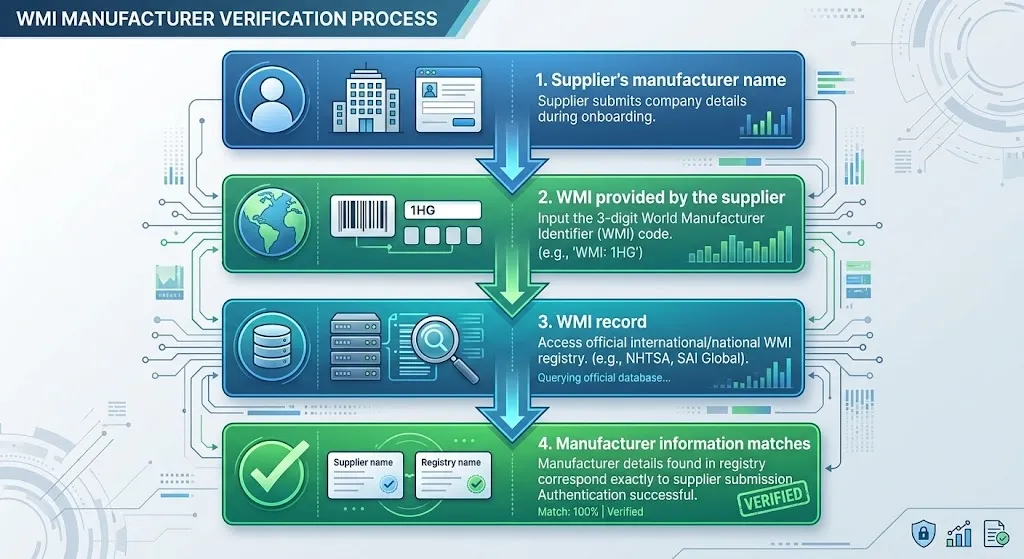
If the information is consistent, you have completed an important basic manufacturer check.WMI is not a quality certification. It does not prove production capacity, product quality or after-sales performance.It is simply a useful tool for checking manufacturer identity and vehicle traceability.For a first supplier review, that is usually enough for this stage. You can then move on to the actual vehicle.
- Verify the Exact Vehicle You Are Buying
After verifying the manufacturer, the next question is:Is the vehicle you are buying the same vehicle that you evaluated?This sounds obvious, but it is an important step.
Electric cargo tricycle manufacturers often have several models based on similar chassis. The same basic vehicle may also have different motor powers, battery configurations, cargo boxes, controllers and optional equipment.
A catalogue photograph alone does not tell you the exact configuration.
Before ordering, confirm the main specifications.
Item | What to verify |
Model | Exact model designation |
Dimensions | Overall length, width and height |
Motor | Rated power and type |
Battery | Chemistry, voltage and capacity |
Controller | Configuration where relevant |
Cargo box | Size and construction |
Payload | Supplier's stated working payload |
Braking | Brake configuration |
Tyres | Size and type |
Maximum speed | Stated specification |
Charger | Charging voltage and specification |
Options | Canopy, doors, lights, mirrors, etc. |
You do not need to turn this into a complicated engineering document.The purpose is simply to make sure that the quotation, technical information and final order refer to the same vehicle.
This is particularly important when comparing several Chinese suppliers.Two vehicles may look almost identical in photographs while having significantly different configurations.
4. Check the Requirements of Your Target Market
A vehicle that can be manufactured does not automatically mean that it can be registered or operated in every country.Before placing an order, identify the basic requirements of your destination market.Depending on the country and intended use, these may include:
- Vehicle category
- Type approval or other approval requirements
- Registration requirements
- Lighting and braking requirements
- Maximum speed or power limits
- Vehicle identification requirements
- Import documentation
- Battery and transport documentation
For European projects, for example, buyers may need to verify the relevant EU type approval and vehicle documentation rather than relying only on a catalogue specification or a general CE statement.
This article is focused on supplier due diligence, so we will not go deeply into those technical approval questions here.
The important point is:Know what your market requires before you finalize the vehicle configuration.Detailed vehicle approval and compliance-document verification should be treated as a separate step.
5. Verify the Production Before Shipment
You do not necessarily need to travel to China to perform a basic supplier verification.There are several practical ways to check production.
Remote verification
Ask the supplier to show the factory and production process through photographs, video or a live video call.If possible, ask to see:
- Welding area
- Painting area
- Assembly line
- Finished vehicles
- Vehicle nameplates
- Production materials
- Battery area
- Loading area
A video can be more useful than a collection of old factory photographs.You can also ask the supplier to show the specific model you are considering.
Factory visit
For a larger order or potential long-term cooperation, visiting the factory can provide additional information about:
- Production facilities
- Engineering capability
- Manufacturing process
- Quality control
- Storage
- Actual production scale
However, a factory visit is not always necessary for a first transaction.
Third-party inspection
For a significant first order, an independent inspection before shipment can provide another layer of verification.Depending on the project, the inspection may check:
- Quantity
- Vehicle model
- Main specifications
- Appearance
- Accessories
- Packaging
- Vehicle identification
- Loading condition
The objective is simple:Confirm that the goods being shipped are the goods you ordered.
6. Watch for Practical Red Flags
Supplier verification does not mean assuming every supplier is suspicious.It means identifying problems that deserve clarification before money is committed.Here are some practical warning signs.
Red Flag 1: The manufacturer cannot be clearly identified
The supplier only provides a brand name or sales profile but cannot provide basic manufacturer information.
Red Flag 2: Product specifications keep changing
The motor, battery, dimensions, payload or other major specifications change repeatedly during discussions without a clear reason.
Red Flag 3: The supplier cannot provide meaningful product documentation
The supplier relies almost entirely on catalogue photographs and general marketing statements but cannot provide basic technical information for the actual model.
Red Flag 4: Factory verification is impossible
The supplier refuses reasonable requests to show the production facility or provide evidence that the vehicle is actually being manufactured.
Red Flag 5: Pre-shipment verification is completely rejected
For a substantial commercial order, the supplier does not accept any reasonable method of checking the goods before shipment.
Red Flag 6: Important commercial terms remain unclear
Price, payment terms, production lead time, warranty or shipment responsibilities are still unclear when the supplier is asking for a deposit.
None of these points should automatically be treated as proof of a bad supplier.
The important question is whether the issue can be reasonably explained and resolved.
7. Review the Order Before You Pay
Once you have verified the supplier and the vehicle, perform one final review before paying the deposit.You do not need dozens of documents.You need to make sure that the supplier, vehicle, commercial terms and shipment requirements are consistent with what you agreed to buy.
Area | What to confirm before payment |
Manufacturer | Manufacturer identity and WMI have been checked |
Vehicle | Exact model and main configuration |
Specifications | Motor, battery, dimensions and other key specifications |
Quantity | Number of vehicles |
Price | Unit price, Incoterm and included costs |
Payment | Deposit, balance and payment conditions |
Production | Estimated production lead time |
Documents | Required export and market documents |
Warranty | Warranty period and covered components |
Spare Parts | Spare-parts arrangement where applicable |
Packaging | Packaging method and shipping marks |
Inspection | Pre-shipment inspection arrangement |
Shipment | Loading and shipping-document requirements |
Before making the first payment, you should be able to answer four simple questions:
- Who am I buying from?
- What exact vehicle am I buying?
- What are the agreed commercial terms?
- What documents and goods will I receive?
If these points are clear, you have completed the basic supplier due-diligence process.
FAQ
How do I verify an electric cargo tricycle supplier in China?
Start by identifying the actual manufacturer and checking its WMI where applicable. Then verify the exact vehicle configuration, review the destination-market requirements, check the production facility and consider pre-shipment inspection before making the final payment.
How can I check whether a Chinese vehicle manufacturer is real?
Check the manufacturer's legal identity, factory information, product range and WMI where applicable. You can also request a live factory video or arrange an independent factory or production inspection.
What is WMI and why does it matter?
WMI stands for World Manufacturer Identifier. It is part of the vehicle identification system used to identify a vehicle manufacturer. It can help buyers verify manufacturer identity and vehicle traceability.
WMI is not a product-quality certification.
Should I visit the factory before placing an order?
Not necessarily. A factory visit can be useful for larger projects, but document review, WMI verification, remote factory verification and pre-shipment inspection can also provide useful information for a first order.
Should I order a sample first?
A sample can be useful when you need to evaluate the physical vehicle, but electric cargo tricycles are relatively large commercial vehicles and shipping a single unit can be expensive.
For some buyers, it may be more practical to combine supplier verification, technical-document review and third-party inspection before moving to a larger order.
What is the biggest mistake when buying from a new supplier?
Focusing only on the unit price.A low quotation does not tell you whether the vehicle configuration is correct, whether the supplier can support the required market documentation, or whether the goods will match the agreed specification.A proper first-order review should look at the supplier, vehicle, production and commercial terms together.
A Practical Approach to Supplier Verification
When sourcing commercial electric cargo tricycles from China, supplier verification does not have to be complicated.A practical process is:
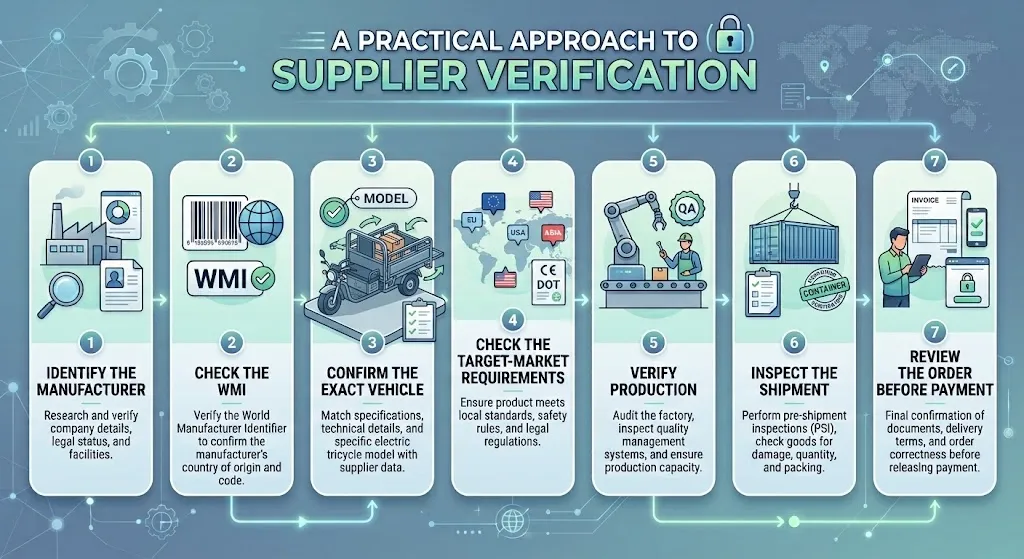
The objective is not to eliminate every possible risk.No international transaction can do that.The objective is to identify the important risks before they become expensive problems.
For commercial vehicle buyers, this is usually a better starting point than simply comparing factory quotations.
Once the supplier itself has been verified, the next step is to verify the vehicle's approval and compliance documents — particularly when the vehicle will need registration or road use in the destination market.
For more product purchasing guidance, please read the following related articles.
How to Choose the Right Electric Cargo Tricycle for Your Business
Electric Cargo Tricycle Manufacturers in China: 2026 Sourcing Guide
How to Choose High-Quality Electric Tricycles for Internal Logistics Operations
How to Maximize Battery Lifespan in Port & Industrial Electric Tricycles: A Procurement Guide
Reducing TCO in Port Internal Logistics: How Define "High-Quality" Through Operational Certainty
Lead-Acid vs Lithium Battery: Which Is Right for Exporting Electric Tricycles?
How to Choose a Truly "Controllable" Electric Tricycle for last mile delivery
How to Make Your Electric Tricycle Run Longer: 12 Practical Maintenance Tips for Maximum Battery Life
How to Choose the Right Electric Tricycle: Port, City, and Home Applications Explained