Oct 12, 2026Field Insights
Electric Cargo Tricycle Industry Transformation: From Price Competition to Compliance Manufacturing
Learn how compliance, EU Type Approval, manufacturing consistency, quality control, TCO and supplier support affect electric cargo tricycle procurement. A practical guide for distributors, importers a
Electric Cargo Tricycle Industry Transformation: From Price Competition to Compliance Manufacturing
From Purchase Price to Total Cost of Ownership: How Should Overseas Buyers Evaluate Electric Cargo Tricycle Manufacturers?
As electric cargo tricycles expand from traditional short-distance transport into agricultural transport, industrial logistics, commercial delivery, construction sites, and other professional applications, the priorities of overseas buyers are also changing.
In the past, purchasing an electric cargo tricycle often started with one simple question:“What is your best price?”
For commercial vehicle projects, however, purchase price is only one part of the total business equation.Overseas buyers increasingly need to consider:
- Vehicle category
- EU Type Approval
- Certificate of Conformity (CoC)
- Conformity of Production (CoP)
- Manufacturing consistency
- Component quality
- Spare parts availability
- After-sales support
- Import and logistics costs
- Vehicle downtime
- Customer complaints
- Distributor reputation
- Total Cost of Ownership (TCO)
For applicable L-category vehicles, Regulation (EU) No 168/2013 establishes a framework covering type approval, conformity, and conformity of production.
Therefore, compliance is not simply about obtaining a certificate.It connects vehicle design, approved configuration, manufacturing processes, production consistency, vehicle documentation, and long-term commercial support.For distributors, this is particularly important.
A vehicle problem does not always stop at the vehicle itself. If an end customer experiences repeated breakdowns, poor finishing, difficult spare-parts supply, or inconsistent vehicle performance, the distributor is often the first party expected to provide an explanation.
That is why the way buyers evaluate an electric cargo tricycle supplier is gradually changing—from “How much does the vehicle cost?” to “What commercial risk comes with this vehicle?”
Key Takeaways
- EU Type Approval applies to an approved vehicle type, while a CoC confirms conformity of an individual produced vehicle.
- CoP (Conformity of Production) helps ensure that mass-produced vehicles remain consistent with the approved type.
- OEM customization should be reviewed against the existing approval configuration before production.
- TCO includes more than vehicle purchase price. For distributors, it can also include warranty claims, spare parts, customer complaints, reputation risk, and lost sales opportunities.
- Supplier evaluation should consider manufacturing consistency, documentation, after-sales support, and supply-chain control—not price alone.
1. Why Should Overseas Buyers Look Beyond the Price of an Electric Cargo Tricycle?
A quotation normally shows only the visible part of the transaction:
Vehicle Price + Shipping Cost = Landed Cost
But the commercial reality can be more complicated.For a distributor, the real cost may also include:
- Warranty claims
- Spare parts
- Technical support
- Replacement vehicles
- Customer complaints
- Technician labor
- Inventory carrying costs
- Delayed deliveries
- Lost repeat orders
- Negative customer reviews
- Pressure from competing brands
For a fleet operator, the same vehicle problem may appear as:
- Downtime
- Reduced productivity
- Higher maintenance costs
- Missed deliveries
- Additional labor
- Lower vehicle utilization
This is why a lower purchase price does not automatically produce a lower TCO.A simple example,Suppose two suppliers offer similar electric cargo tricycles:
- Supplier A offers a lower initial price.
- Supplier B costs slightly more but provides more consistent production, clearer documentation, better spare-parts support, and a more structured quality-control process.
If Supplier A's vehicles subsequently generate significantly more warranty claims and technical problems, the initial price advantage can disappear.For a distributor, the consequences may extend even further.
The distributor may have to:
- Handle the customer's complaint.
- Diagnose the technical problem.
- Contact the manufacturer.
- Wait for replacement parts.
- Pay local labor costs.
- Explain the delay to the customer.
- Protect the relationship with the customer.
- Deal with the possibility of negative reviews or lost future orders.
The vehicle may be manufactured by the supplier, but the customer relationship is usually owned by the distributor.That distinction is important when evaluating suppliers.
2. What Is the Difference Between Type Approval, CoC and CoP?
These three concepts are often confused during international electric vehicle procurement.
Type Approval confirms that a defined vehicle type and its relevant characteristics have been assessed against the applicable regulatory requirements.It relates to the approved vehicle type, rather than simply one physical vehicle.For European L-category vehicles, the applicable approval framework depends on the vehicle category and technical characteristics.
A Certificate of Conformity (CoC) is associated with an individual vehicle.It confirms that the particular vehicle was manufactured in conformity with the approved type.Therefore:
Type Approval = approved vehicle type
CoC = conformity of an individual vehicle
They are related, but they are not the same document or concept.
Conformity of Production (CoP):addresses the production stage.The purpose is to ensure that vehicles manufactured after approval continue to conform to the approved type and applicable requirements.This is particularly important when a vehicle is produced repeatedly in large quantities.A useful way to understand the relationship is:
Type Approval → CoC → CoP
Approval defines what the vehicle type is.
CoC connects an individual vehicle to that approved type.
CoP helps maintain consistency throughout ongoing production.
3. Why Is Conformity of Production Important to Overseas Buyers?
For a buyer importing one vehicle, production consistency may seem like a technical issue.For a distributor importing dozens or hundreds of vehicles, it becomes a commercial issue.Imagine receiving the first batch of vehicles and finding that:
- The motor specification has changed.
- A controller supplier has changed.
- The wiring arrangement is different.
- The cargo box structure has been modified.
- The braking components have changed.
- Vehicle dimensions are slightly different.
- Electrical components behave differently between batches.
Not every component change automatically means that an approval becomes invalid.The important question is whether the change affects characteristics covered by the approved type and whether the manufacturer has properly evaluated and controlled the change.
This is where production control matters.
A mature manufacturing system should have a process for:
- Identifying critical components
- Controlling supplier changes
- Documenting engineering changes
- Checking production specifications
- Maintaining production records
- Conducting inspections
- Managing non-conforming products
- Ensuring the finished vehicle remains consistent with the approved configuration
From our production monitoring perspective.One of the practical lessons from export-oriented vehicle production is that consistency between batches can be just as important as the specification of the first vehicle.
A sample vehicle can look excellent.The more important question for a commercial buyer is:
Will vehicle number 50, 100, or 500 still match the same production standard?
That is one of the reasons CoP and production-control processes matter to overseas buyers.
4. Compliance Manufacturing Does Not Stop at the Certification Authority
Obtaining approval is only one part of the process.A commercial vehicle manufacturer still needs to translate the approved design into repeatable manufacturing.
This involves areas such as:
- Engineering documentation
- Bill of materials
- Component control
- Welding processes
- Surface treatment
- Electrical assembly
- Inspection procedures
- Final testing
- Production records
- Change management
The important point is simple:A certificate describes an approved vehicle type. It does not manufacture the vehicle for you.
The actual production process determines whether each physical vehicle continues to match the required configuration and manufacturing standard.This is particularly important for buyers who plan to build a long-term distribution program rather than purchase a small number of trial vehicles.
5. Quality You Cannot See in a Specification Sheet: Frame and Welding
The frame is one of the fundamental structural components of an electric cargo tricycle.
A specification sheet may tell you:
- Steel type
- Tube dimensions
- Frame structure
- Vehicle payload
- Wheelbase
- Overall dimensions
But it usually does not tell you how the frame is actually manufactured. Two manufacturers may list similar steel specifications while using very different production processes.Important factors include:
- Cutting accuracy
- Jig and fixture control
- Welding sequence
- Weld penetration
- Joint preparation
- Weld finishing
- Grinding
- Reinforcement
- Dimensional inspection
- Corrosion protection
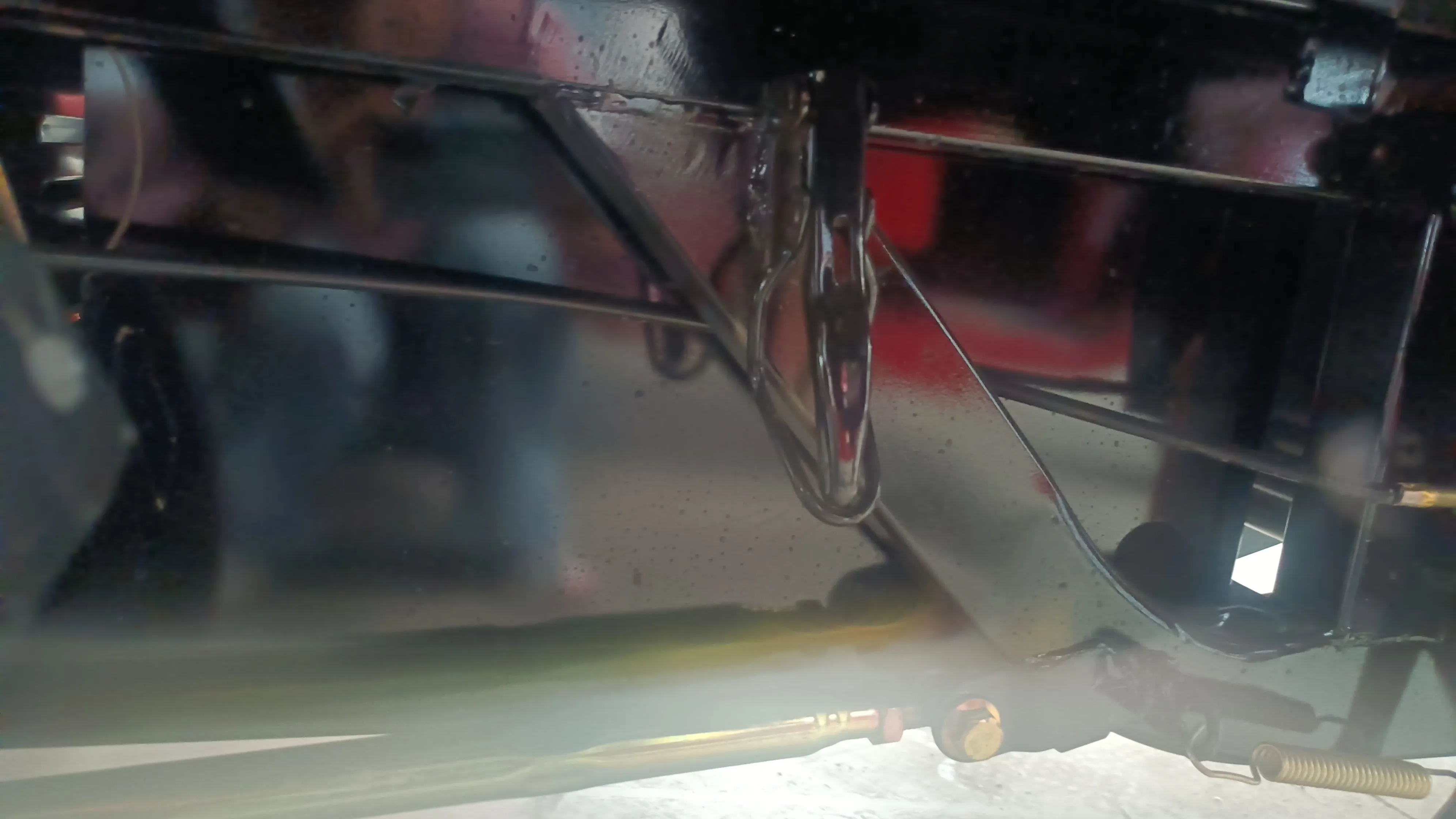
For many standard models, robotic welding can provide high efficiency and consistent welding positioning.For certain EEC models, however, manual welding is used for specific structural areas because the process involves more than simply completing the weld.
After welding, some joints may require:
- Grinding
- Smoothing
- Local reinforcement
- Appearance inspection
- Additional finishing
The objective is not to claim that manual welding is automatically better than robotic welding.The important point is that the manufacturing process should match the structure and the requirements of the vehicle.
What We Have Observed in Production Monitoring
In export-oriented production, we have found that the condition of the welded joint after welding is completed can be just as important as the welding operation itself.For this reason, critical structural areas can be subject to additional visual and finishing checks before the vehicle moves to subsequent production stages.
This is a small example, but it illustrates a broader principle: Manufacturing quality is often determined by the details between the major production steps.
These details normally do not appear in a quotation sheet, but they can influence the vehicle's long-term performance, appearance, and maintenance requirements.
6. Why Does Surface Treatment Matter?
A commercial electric cargo tricycle may operate outdoors every day.
Depending on the application, it can be exposed to:
- Rain
- Humidity
- Mud
- Dust
- Fertilizer
- Road salt
- Industrial environments
- Repeated loading and unloading
Therefore, surface treatment is not simply an appearance issue.The important factors include:
- Surface preparation
- Welding-joint treatment
- Rust prevention
- Coating consistency
- Coverage of difficult areas
- Paint adhesion
- Final inspection
For buyers, a useful question is not simply:“What paint do you use?”
A better question is:“What is your complete surface-treatment process from prepared steel to finished vehicle?”This helps distinguish a specification from an actual manufacturing process.
7. The Electrical System Is Also Critical to Commercial Vehicle Quality
The electrical system is another area where component consistency matters.An electric cargo tricycle may contain:
- Motor
- Controller
- Battery
- Charger
- Display
- Wiring harness
- DC/DC converter
- Switches
- Lighting system
- Protection devices
A vehicle can have a high-power motor on paper and still perform poorly if the motor, controller, battery and wiring system are not properly matched.For commercial applications, buyers should therefore look beyond motor power.Important questions include:
- Is the motor specification consistent between batches?
- How is the controller matched to the motor?
- How are wiring connections protected?
- How are electrical components tested?
- How are component changes documented?
- What happens if a key supplier changes?
Based on recent export projects,One practical issue we repeatedly see in international vehicle projects is that buyers often focus heavily on the motor and battery specification while paying less attention to the relationship between the electrical components.
In actual operation, however, the system works as a whole.Motor power, controller settings, battery characteristics, wiring, charging system and vehicle load all interact.For this reason, evaluating an electric cargo tricycle only by a single number such as “1500W” or “2000W” can give an incomplete picture.
8. OEM Customization Does Not Mean Every Parameter Can Be Changed Freely
OEM customization is an important part of commercial electric cargo tricycle projects.
Typical customization may include:
- Cargo box dimensions
- Cargo box materials
- Branding
- Lighting
- Canopy
- Color
- Seating arrangement
- Accessories
- Local market configuration
However, customization has a boundary.Some changes may be ordinary commercial customization.Others may affect technical parameters covered by the existing approval.For example, changing:Vehicle dimensions,Maximum mass,Motor characteristics,Braking system,Lighting configuration,Structural components,Battery arrangement may require additional technical evaluation.
Therefore, a professional supplier should not simply answer:“Yes, we can customize it.”The more useful answer is:“Yes, but we first need to determine whether the requested change falls within the existing approved configuration.”This is particularly important for type-approved vehicles.The manufacturer should evaluate significant modifications against the existing approval documentation before production.
9. What Should Overseas Buyers Ask an Electric Cargo Tricycle Manufacturer?
Instead of asking only:“What is your best price?”buyers can use a structured supplier evaluation framework.The following checklist can be copied directly into an initial supplier inquiry.
Supplier Due Diligence Checklist
Evaluation Area | Specific Question | What You Are Testing |
Legal / Compliance | “Which specific WVTA number covers this model?” | Is the approval valid and applicable to the exact vehicle type? |
Documentation | “Can you provide the relevant type-approval documentation for this configuration?” | Can the supplier demonstrate what has actually been approved? |
Production Control | “How do you ensure mass-produced vehicles match the approved configuration?” | Does the supplier have practical CoP and production-control procedures? |
Supply Chain | “Are critical components such as the motor, controller and battery from single-source or multi-source suppliers?” | What is the risk of supply disruption or specification variation? |
Engineering Change | “How do you document changes in key components?” | Is there a controlled engineering-change process? |
Quality Assurance | “What tests are performed on every unit before packing?” | Does final inspection include functional testing rather than visual inspection only? |
Frame / Welding | “How are critical frame welds inspected and finished?” | How does the manufacturer control structural manufacturing quality? |
Customization | “Does changing the cargo box dimensions require additional approval review?” | Does the supplier understand the boundary between OEM customization and compliance? |
After-sales | “How are spare parts supplied after delivery?” | How quickly can technical problems be resolved? |
Market Support | “Do you have local stock or partners for spare parts in [Target Country]?” | What is the potential downtime risk? |
Logistics | “Is the vehicle shipped as CBU or SKD?” | What are the implications for shipping volume, import costs and local assembly? |
Practical Note: This checklist is based on common issues encountered when evaluating cross-border commercial vehicle projects. It is intended as a starting point for supplier due diligence rather than a substitute for country-specific legal or technical requirements.
A supplier does not necessarily need to answer every question in exactly the same way.What matters is whether the supplier can explain how its products are designed, approved, manufactured, inspected and supported.
10. Don't Compare Electric Cargo Tricycles by FOB Price Alone: Build a TCO Model
TCO is often discussed from the perspective of fleet operators.
For example:Purchase Price + Energy + Maintenance + Downtime + Labor = Operating Cost
But distributors should look at TCO from another angle.For a distributor, the commercial cost of a problematic vehicle can extend beyond the vehicle itself.
Distributor TCO,A distributor may need to consider Purchase Cost:
- Import & Logistics
- Spare Parts
- Warranty Handling
- Local Technical Support
- Customer Service Labor
- Replacement / Repair Costs
- Inventory Costs
- Downtime Impact
- Lost Repeat Orders
- Reputation Risk
The last two items are difficult to calculate, but they can be commercially significant.
10.1 Customer Trust
A customer who buys one commercial vehicle is not necessarily buying only the vehicle.They are also buying the distributor's promise that the product will be supported.If a new vehicle repeatedly develops problems, the customer may not distinguish between:“The manufacturer's problem”and“The distributor sold me a problematic vehicle.”From the customer's perspective, the distributor is usually the visible party.
10.2 Distributor Reputation
For a distributor building a local market, reputation can take years to develop.
One problematic batch can create:
- Negative customer feedback
- More warranty discussions
- Increased technical-support workload
- Greater pressure on sales staff
- Lower confidence from new customers
- More difficult negotiations with fleet customers
This means product quality can affect the distributor's brand equity, even when the distributor did not manufacture the vehicle.
10.3 Profitability
The margin on the original vehicle sale is not the entire profit calculation.Consider two vehicles:
Item | Supplier A | Supplier B |
Initial purchase price | Lower | Higher |
Expected warranty workload | Higher | Lower |
Spare-parts requirement | Higher | Lower |
Technical support | More frequent | Less frequent |
Customer complaints | More frequent | Less frequent |
Repeat-order potential | Uncertain | Depends on product performance |
Initial margin | Higher | Lower |
Long-term commercial cost | Potentially higher | Potentially lower |
This table does not mean that the more expensive supplier is always the better choice.
It illustrates why initial purchase price and total commercial cost are not the same measurement.
10.4 Competitive Pressure
Distributors also operate in competitive markets.
If competing brands offer more reliable vehicles, better spare-parts availability, or faster technical support, a distributor may face pressure not only on sales volume but also on pricing.
Therefore, product reliability can indirectly influence:
- Selling price
- Gross margin
- Customer retention
- Market reputation
- Sales conversion
- Repeat orders
For a distributor, the real question is not simply:“How much can I save when purchasing this vehicle?”It is:“How much commercial risk am I accepting in exchange for the lower purchase price?”
11. How Should Buyers Compare Electric Cargo Tricycle Suppliers?
After reviewing compliance, production, quality, customization, and TCO, buyers can use a simple framework to compare suppliers.
Instead of comparing only the FOB price, compare the supplier across five areas:
Area | Key Questions |
Compliance | What vehicle category and approval apply to this model? |
Manufacturing | Can the supplier consistently reproduce the approved configuration? |
Quality | How are key structural, electrical, and finishing processes controlled? |
Support | How are spare parts, warranty issues, and technical problems handled? |
Commercial Cost | What is the potential impact on maintenance, downtime, customer satisfaction, and distributor reputation? |
The objective is not to identify the supplier with the highest specification or the lowest price.It is to understand the complete supply package and its associated commercial risks.
12. FAQ: Electric Cargo Tricycle Compliance and Procurement
Q1:Do I need EU Type Approval to sell electric tricycles in Europe?
For L-category vehicles that fall within the applicable EU type-approval framework, the relevant vehicle must comply with the applicable approval requirements.The exact requirements depend on the vehicle category, technical characteristics, intended market, and applicable national procedures.
Q2:Can I customize the battery size on a certified electric tricycle?
Customization may be possible, but the proposed configuration should first be evaluated against the existing approval documentation.Changes to the battery, electrical architecture, or related components may affect characteristics covered by the approved type.
Q3:What should I check before buying an electric cargo tricycle from China?
At minimum, review:
- Vehicle category
- Type Approval, where applicable
- Approved configuration
- Production consistency
- Key component control
- Quality inspection
- Spare-parts support
- Warranty process
- CBU / SKD logistics
- Target-market import and registration requirements
For larger projects, a sample inspection, factory audit, document review, and production-process assessment can provide additional information before an order is placed.
13. From Price Comparison to Supply-Chain Evaluation
The electric cargo tricycle purchasing process is becoming more complex as these vehicles move into professional commercial applications.For overseas buyers, the key question is no longer simply:
“How much does this vehicle cost?”It is:“Can this supplier consistently deliver the required vehicle, documentation, quality, and support?”
For fleet operators, this affects operating costs and vehicle availability.
For distributors, it also affects customer trust, warranty workload, reputation, and future sales.
That is why a practical supplier evaluation should connect five elements:
Compliance → Manufacturing → Quality → Support → Total Commercial Cost
A competitive supplier is not simply one that offers a competitive quotation.It is one that can provide a consistent vehicle, controlled production process, appropriate documentation, reliable support, and a workable long-term supply arrangement.
Final Thought
The lowest purchase price may be attractive at the beginning of a project.But for a commercial vehicle that will be used for years, the more important question is what happens after the vehicle leaves the factory.
The right evaluation helps buyers understand that before placing the order.
The right vehicle.The right production process.The right documentation.The right support.
That is the foundation of a sustainable commercial electric cargo tricycle supply program.
Need to Evaluate an Electric Cargo Tricycle Project?
Before production, we can help review:
- Vehicle application
- Target-market requirements
- EU Type Approval requirements
- Vehicle configuration
- OEM customization
- CBU / SKD shipping options
- Production considerations
- Spare-parts planning
Contact us for a project review before production.
For more product purchasing guidance, please read the following related articles.
How to Choose the Right Electric Cargo Tricycle for Your Business
Electric Cargo Tricycle Manufacturers in China: 2026 Sourcing Guide
How to Choose High-Quality Electric Tricycles for Internal Logistics Operations
How to Maximize Battery Lifespan in Port & Industrial Electric Tricycles: A Procurement Guide
Reducing TCO in Port Internal Logistics: How Define "High-Quality" Through Operational Certainty
Lead-Acid vs Lithium Battery: Which Is Right for Exporting Electric Tricycles?
How to Choose a Truly "Controllable" Electric Tricycle for last mile delivery
How to Make Your Electric Tricycle Run Longer: 12 Practical Maintenance Tips for Maximum Battery Life
How to Choose the Right Electric Tricycle: Port, City, and Home Applications Explained